Showing posts with label insects. Show all posts

Thursday, August 21, 2014

Non-Emerald Ash Borer Ash Problems

    Emerald ash borer (EAB) is eventually going to come and kick some major ash in Pulaski County KY.  However, even without this pest, ashes have their share of problems.  Let's go over a few of the most common.
     Ash/lilac borer -- unlike EAB, these borers tend to infest already stressed ash trees.  Symptoms include tree decline (thinning canopy) and round exit holes.  http://www.extension.iastate.edu/NR/rdonlyres/B43B7D89-BD6C-48DA-B9B1-EF96214DBB8D/78666/AshLlilacBorerPupalCase.jpgPictured here is a pupal case that is often observed on the bark of ash trees.  All borers are hard on trees and will cause thinning of the canopy and general decline.
     Ash anthracnose -- this fungal disease usually hits in cool, moist springs. Brown spots develop on the leaves, leaves will usually fall off, but the tree will regrow a new set of leaves.  This is not good for the tree as it has to have double the energy supply to create a whole new set of leaves. You may see general dieback of the canopy if the tree is infected multiple seasons.

     General decline -- this omnipresent problem is hard for many tree owners to understand. As much as we like to think trees live forever, they don't. Drought, floods, improper pruning, planting too deeply, changing the grade, and trenching near a tree can all cause the tree to be unthrifty and be the start of a downward spiral.


Monday, July 28, 2014

Emerald Ash Borer in Pulaski Co


     The emerald ash borer has been trapped in far eastern Pulaski County.  Three individuals were trapped at the Bee Rock Campground near the Rockcastle River.  Just because EAB was confirmed here, it's still hard to know how widespread the critter is.
     Specialists at the University of Kentucky recommend treating high value ash trees.  I would certainly concur. Unfortunately, the best time for treating trees is in the spring. So, for now, not much to do.
     What you can do now is this: read up about the pest and its treatment options: http://www.emeraldashborer.info/files/Multistate_EAB_Insecticide_Fact_Sheet.pdf.  Most of us will go with the homeowner option of imidacloprid (Bayer AdvancedTM Tree and Shrub Insect Control or OptrolTM).  If your tree is less than 20 inches in diameter, it can be treated successfully.  It takes 4 to 6 weeks for the pesticide to be taken up and distributed throughout the tree.
PictureEmerald ash borer     Imidacloprid should be applied in mid-March to late April. The rate is dependent on how large the tree is.  If you need help measuring, please let me know as I have a diameter tape that measures trunk diameter.  This treatment will have to be repeated on an annual basis.
    For more information or questions, please don't hesitate to call the Pulaski County Extension Service at 606-679-6361 or email me at beth.wilson@uky.edu 


Monday, July 16, 2012

Blister Beetles Now Appearing

Blister Beetles Appearing

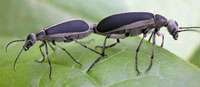
Blister beetle 
Margined blister beetles

Blister beetles can be quite a sight in the home garden.  About this time of year, their populations build up to incredible numbers.  They amass on and can defoliate plants in a day or two if the infestation is severe enough. They seem to prefer plants in the Solanaceous family like tomatoes, eggplant, and peppers.


Beetles are about a half-inch long.  Their name comes from the defensive chemical, a blistering agent, that is released when they are handled or disturbed. These insects are most active in the morning and late afternoon and may disappear during the hottest part of the day. They are easily disturbed and will drop off the plant or run away if disturbed.

The striped blister beetle has a yellow-orange head and body with three long black stripes running along each wing cover. It will feed on many different vegetables but seems to prefer the fruits of solanaceous plants. They also are foliage feeders with big appetites. Striped blister beetles form large mobile feeding masses so they can descend on an area and cause a lot of damage in a short time. Other species in the area include the black blister beetle and the margined blister beetle. The latter has a black body with thin gray stripes along the wing covers and a gray abdomen. These two species frequently feed on flowers, the black blister beetle can be found on alfalfa flowers.

Pyrethroid products work well against blister beetles.  Neem may be of help as a feeding deterrent.  Organic controls include Neem, spinosad products, and shaking the beetles into soapy water.

Blister beetles can kill horses. For more information, http://www.ca.uky.edu/entomology/entfacts/ef102.asp 

Wednesday, September 01, 2010

Why Are There More/Fewer _____ This Year?

This interesting article comes from Lee Townsend, UK Extension Entomologist. We always attribute less insects with a harsh winter. Not so, he says. Read on:

Why are there So Many/Fewer _(Fill in the Name)_ This Year?
By Lee Townsend

Almost every year it seems that one or more species of insects are more/less abundant than “normal”. Sometimes increases are appreciated, as with lightningbugs or fireflies this summer. Just a few years ago, we were wondering why they were so scarce. On the other hand, increases in pests of crops, landscape plants, or humans can pose serious problems.

Weather, particularly temperature and rainfall, have major impacts on insect survival which can lead to significant increases (or decreases) in insect numbers from one year to the next. And, the effects are not consistent across species; conditions that allow some to thrive may be detrimental to others.

As a cold-blooded animal, insect development is accelerated or slowed depending upon temperature. A very warm spring can shorten the number of days required to grow from egg to adult. In turn, rapid development can reduce the length of exposure of vulnerable stages to predators so that a smaller percentage is eaten by natural enemies. It also can result in an extra generation of the insect. Longer warm periods also can mean species normally restricted to southern regions can move further north.

Rainfall amount and timing also plays a big role in insect population dynamics. Heavy spring rains leave areas wet for prolonged periods of time that favor some species. Increased nectar and sap flow is a boon to nectar gathers and sap feeders, including bees, butterflies, scale insects, and aphids. And, fungus-feeding insects benefit from an increased food supply. On the other hand, these same rains can wash small caterpillars and sap feeders off of plants to perish before they can find another host plant.

Weather also affects food abundance and quality from the insect’s perspective. The higher nutritional value of healthy, vigorous plants may result in more rapid insect development and more offspring per female. In some cases, plant development may be better synchronized with that of the insects that pollinate them or use them as some other resource. The impact of weather on some species can even be delayed. The apparent increased incidence in attacks of borers may be traced to the damage from past ice storms or droughts that stress, weaken, or kill trees and shrubs.

While temperature and rainfall have been identified as driving the population dynamics of many insect species, a myriad of factors other can be involved. In fact, the key factors governing survival and success are somewhat understood for only a few species. It is clear that only small increases or decreases in the relatively high mortality rate of most insects can lead to very big fluctuations in their numbers.

Friday, July 09, 2010

Turf Research Field Day

Turf is a horticulture crop unto itself. And as such, UK hosts annual field days about turf and only turf. I try to go every other year or so. Here's a few tidbits of information gleaned from a hot day yesterday.
  1. There are a TON of tall fescue varieties out there and we do highly recommend tall fescue for home lawns. However, there are so many good 'turf-type' tall fescues out there that using KY 31 (the old, old forage variety) hardly makes sense anymore. Get yourself a good turf-type tall fescue variety and watch a very attractive grass grow!
  2. The most destructive grub (larvae of beetles) of turf is the grub of the masked chafer. I bet you thought I was going to say Japanese beetle, didn't you? The masked chafer is a brown, half-inch long beetle that skims over the turf surface at dusk.
  3. Dr Dan Potter, UK Entomologist, noted that Emerald Ash Borer is not spreading as fast in KY as it has in other states, like Michigan. He's not sure why, but one speculation is that we are at the southern range of this pest. Only time will tell.
  4. UK is working on some green tactics in turf. In particular, AJ Powell, our illustrious, recently retired turf specialist, spoke with us about white dutch clover in home lawns. We saw a study conducted about even a relatively high rate of 2,4-D amine on a fescue/clover lawn will get rid of many broadleaf weeds without reducing the stand of white clover. White clover can contribute up to 2# of nitrogen per 1000 sq ft -- no small amount!
So, there you have it. Some gleanings from the UK Turf Field Day held at Spindletop Farm.

Friday, July 02, 2010

Grasshoppers

Yesterday, I got two calls before 9:30 am concerning the over-abundance of grasshoppers. One was concerned about the sheer numbers of them, the other was concerned about their feeding on her vegetables and flowers.

I've noticed quite a few myself when walking outside in the grass, through the blackberries, or around the barns. I asked the entomologist at UK if there had been other calls like mine in the state and he said no.

If you believe grasshoppers are becoming a pest, especially in your garden, there are synthetic chemical sprays that will help control them in your vegetable garden and flower beds. However, for just being a nuisance, sprays will only win you a battle or 2 -- you won't win the war.

Here's another link on grasshoppers from UK.

Monday, June 21, 2010

Bark Lice City!

Bark lice -- I have gotten numerous calls on this, probably 5 or 6. If I get 5 or 6 calls, you can probably multiply that by 100 to get the real story of how much of this is out there this year.

Bark lice are black bugs that congregate together on the bark of trees. They move as a group and form black blotches on the bark. Not because of the damage they do but because they themselves form the black blotches.

They are not parasites of the tree nor are they something you need to treat for. Why they seem to be more prolific this year is anyone's guess.

Here's a link to Kentucky Pest News featuring an article on bark lice.

Monday, March 29, 2010

Emerald Ash Borer -- Know It & Abhor It

Abhor is such a strong word....but we will all really, really, really not like this critter very much in the near future. I just came from presenting a program to our local Rotary Club on the Emerald Ash Borer (EAB). It's relevant enough that I'll update you on its movement.

Kentucky has 11 counties infested with the EAB.

So far, Pulaski County is not an OFFICIALLY infested county. But think about it....we get a few Ohio visitors each year. These visitors may bring infested firewood with them. Ohio has had this pest for a couple of years already.

Or maybe a shipment of ash trees for a landscaping business or nursery comes in already infested. That's all it takes for these insects to get started.

During late April or early May, EABs will emerge and begin doing what insects do best -- eating, mating, and flying. Maybe all of them at once!

We need help in tracking this insect, so I simply ask you keep your eyes open. If you see any of the symptoms (found on the website links above), please call me at 606-679-6361.

Tuesday, October 13, 2009

Bagging Apples

Ever heard of this? Apple bagging is simply placing individual apples inside bags while they are still on the tree. Bags are put on when fruit is about quarter-sized. Bags remain on til about 3 weeks before harvest. Bagged apples will not color up properly, so taking them off well before harvest is a must.

Why, why, oh why would anyone do this? Well, apples get plenty of disease and insect pests. Most backyard fruit growers do not want to apply lots of pesticides. So....by bagging fruit we are physically keeping the pest off the fruit without having to spray. An organic pest control method.

In addition to using the Japanese apple bags (from the website above), a UK entomologist gave me some nylons. Yes, there is anecdotal evidence that nylons (like what women slip on when trying on shoes) can work to deter pests.

I grow Liberty apple which is very disease resistant, but no apples are insect resistant. Here are my photos of bagged, nyloned, and not-bagged apples.


Pretty cool. But let me tell you, putting bags on apples is dang time consuming, especially the Japanese apple bags. Most of the bags I had put on had fallen off mid-season. The nylons were much easier to put on and did not tend to come off with bad storms and weathering.

The bagged apple was the biggest of the 3, shown below. And you can see what covered each of the 2 bagged apples.

Thursday, August 27, 2009

Get to Know the Emerald Ash Borer

Emerald ash borer is a nasty, nasty bug. It hasn't been confirmed in Pulaski County but you can bet, we'll be one of the first 10 to 20% of counties in KY to get this insect. It's moving rapidly due to renegade campers moving infested ash firewood to their camping locations. And folks, we have many, many tourists from Ohio -- Ohio has had this pest for a good year or better.

A program dedicated to the emerald ash borer will be held on September 24 at 6pm at the Pulaski Co Extension Service office. Jody Thompson from the KY Division of Forestry will be here to lead the discussion.

There may be some little knick-knacks to giveaway as well. So... come! And bring your questions.