Showing posts with label vegetables. Show all posts

Wednesday, December 04, 2013

Gardening in the Winter? Yep.

     Although 'gardening' is probably not an activity many people think of in the winter, here are some gardening-like things to do while stuck in the doldrums of winter:

DECEMBER
  • Always keep a watering can full of water so that the water can be at room temperature. Don't shock your houseplants by watering with cold water.
  • When bringing poinsettias from the greenhouse to the car and the car to the house, be sure to protect them from the cold. They do NOT like the cold, not one bit.
  • If you have some hollies with berries, prune some to bring inside for decoration
  • If you planted a tree this fall, be sure to mulch it.  It's really important.
  • Fresh cut Christmas trees last longer and pose less fire hazard if you keep them well-watered while in the house.
  • Clay pots that look like this can be soaked in a mixture of 1 gal water: 1 cup bleach: 1 cup vinegar.  Soak them overnight then scrub the crud off.  
  • Wash the dust off houseplants.

JANUARY
  •  Seed time! Start germination tests on old seeds by wetting a paper towel. Place 10-20 seeds on the wet towel, fold or roll it up and place in a ziplock bag.  Remember to label the bag with seed name, cultivar or variety name, and the date you started the germination test. Place these in ambient temperatures and check weekly (or sooner). Poorly germinating seeds can then be discarded.
  • Consider purchasing a heating mat for germinating seeds.  This cuts germination time for many species in half and gets you a jump on things (especially if you run behind like I do).
  • For insect pests like mealybugs or whiteflies, you can spray insecticidal soap on houseplants.  Be sure to get very thorough coverage of the insecticide for best results.
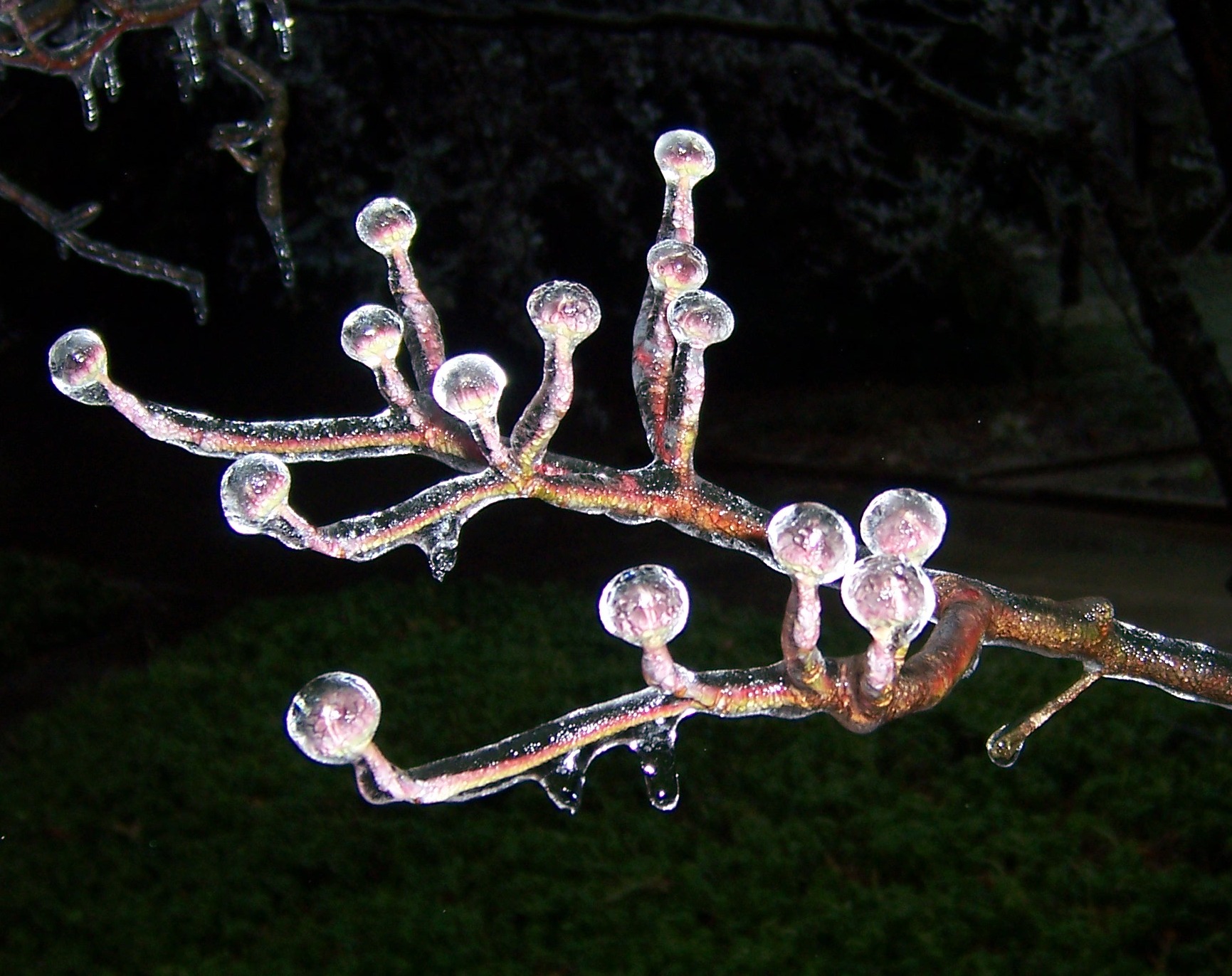
  • In the event of an ice storm, allow ice to melt off plants if possible.  If ice has broken a limb, go ahead and remove the branch to reduce further injury or tearing of the bark.
  •  Check on bulbs that you may have lifted, like dahlias, gladioloas, or cannas. Remove any rotting bulbs.
  • Feed the birds.  Black oil sunflower seeds will attract lots of different birds. Clean and refill feeders regularly.
FEBRUARY

  • Water evergreens if snowfall has been minimal this winter.
  • Cut back ornamental grasses before they begin to grow in March.
  • Mid-month, sow seeds of peas, larkspur, snapdragons outside now.  To bloom best, they must sprout and do much of their growing well before warm weather arrives.
  • If you need to control mites or scale insects, pick a warmish day above freezing to apply a dormant oil spray to your ornamental trees and shrubs.
  • Start onion seed during the first week of February, start broccoli, cabbage, and cauliflower seeds indoors during the 3rd and 4th week of February.
  • Start parsley and thyme seed this month as they take a long time to make a decent-sized transplant. Soak parsley seeds in water for 24 hours prior to planting.
  • Collect scion wood from apple and pear trees.  This is also the time to prune those trees. Store scion wood in moist paper towels or newspaper then seal in a plastic bag and put in the refrigerator until grafting time comes. Apples should not be in the same refrigerator as scion wood.
  • Fertilize fruit trees.
  • Repot rootbound houseplants.  Choose a new container that is only an inch or 2 larger in diameter than the old container.
  • Try forcing some cut woody stems like forsythia, pussy willow, pear, quince, crabapple, or cherry.  Pussy Willow


Check out the classes and other activities going on at the Pulaski County Cooperative Extension Service office! 

Wednesday, December 12, 2012

12/12/12 -- Let's Do 12 New Plants!

On this unique date, let's use it to think about 12 new varieties of vegetables/fruit (today), 12 new varieties of annuals (week of Dec 17), and 12 new types of trees or shrubs (week of Dec 24) for our landscapes.

12 New or Different Vegetables or Fruits to try in 2013
  1. Sprouting broccoli
  2. Shell beans -- I know that beans are one of the cheapest things in the store, but you can't buy Vermont Cranberry beans or Pawnee shell beans at the grocery.
  3. Carrots -- if you think you know what carrots taste like, grow them yourself and be amazed! Try different varieties like 'Purple Haze' or 'Atomic Red'.
  4. Popcorn or cornmeal corn (why not?)
  5. Eggplant -- there are more uses for eggplant than you think, so try it.  They are beautiful as well, varying shapes and sizes.
  6. Snap, snow, or shelling peas -- easy and done by the end of May. Pretty flowers
  7. Fall bearing blackberries &/or raspberries -- Prime ARK 45 (black), Caroline or Heritage (rasp). Easy pruning.
  8. Snacking peppers -- they're small, colorful, and extremely sweet. Johnny's Seed calls them 'Lunchbox Peppers
  9. Blueberries -- soil test first but they are super healthy and easy to grow once soil conditions are correct.  New pink varieties like 'Pink Lemonade', 'Tophat' for containers (oh, and you'll need two varieties)
  10. Garlic -- so easy, just do it.
  11. Cilantro -- either the flat leaf that looks like parsley or try 'Delfino'
  12. Corn salad or mache -- this was Thomas Jefferson's favorite green. Grow it and see why.

Mache (from Johnny's Seed)

Item Photo
Pawnee shell bean (from Seeds of Change)
Orient Charm (F1)
Orient Charm (from Johnny's Seed)

Thursday, July 19, 2012

Potato Harvest for Home Gardeners

At the office, I planted potatoes using a couple of different methods a home gardener might try.

One was the square foot gardening method where I planted potatoes in 2 squares side-by-side.  I used the 'high-rise' method where I built another 1' x 2' x 6" square so that I could add more soil as the potatoes grew.  In total, the square foot gardening method gave me about 12" of depth in which potatoes could form.

5/23/12, about 8 weeks of growth
The other method of raising potatoes was using a grow bag.  I had 2 different colors of these bags (which cost me $20 each).  With this method, you fill up the bag, eventually to the top, as the potato grows. 

4 seed pieces per square planted 3/28/12
Kennebec potatoes were planted on 3/28/12.  Four seed pieces went in each square of the square foot garden and 8 seed pieces were planted into each grow bag. So each method was planted with equal numbers of seed pieces.


8 seed pieces were planted in each bag 3/28/12


So, here's what the plants looked like prior to harvest:


Square foot garden 7/17/12
Tan bag 7/17/12


Black bag 7/17/12

 And here's the harvest 16 weeks after planting:
Left sq ft garden, middle black bag, right tan bag

Pure numbers tell us that the 2 squares of the square foot garden produced the best, yielding 19 potatoes weighing 4.05#.
The black bag ended up producing a lot of little tubers (23 total) weighing in at 2.69#.
The tan bag produced the least (13 tubers in all) weighing 2.13#.

The best quality is dependent on whether you like new potatoes over baking or slicing sized potatoes.  For new potatoes, the black bag produced more smaller ones.  However, I would say the best overall was the sq ft garden harvest.

I suspect that in a 'normal' year (whatever that is) overall, plants would have yielded more.  With temps in the 100s for a week or more, tubers will not (and did not) size up. I suspect that perhaps the medium in which the tubers were forming was cooler in the sq ft garden bed than in the grow bags.  However, I did not measure the temperature.

Happy gardening!


Monday, July 16, 2012

Blister Beetles Now Appearing

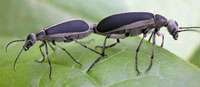
Blister Beetles Appearing

Blister beetle 
Margined blister beetles

Blister beetles can be quite a sight in the home garden.  About this time of year, their populations build up to incredible numbers.  They amass on and can defoliate plants in a day or two if the infestation is severe enough. They seem to prefer plants in the Solanaceous family like tomatoes, eggplant, and peppers.


Beetles are about a half-inch long.  Their name comes from the defensive chemical, a blistering agent, that is released when they are handled or disturbed. These insects are most active in the morning and late afternoon and may disappear during the hottest part of the day. They are easily disturbed and will drop off the plant or run away if disturbed.

The striped blister beetle has a yellow-orange head and body with three long black stripes running along each wing cover. It will feed on many different vegetables but seems to prefer the fruits of solanaceous plants. They also are foliage feeders with big appetites. Striped blister beetles form large mobile feeding masses so they can descend on an area and cause a lot of damage in a short time. Other species in the area include the black blister beetle and the margined blister beetle. The latter has a black body with thin gray stripes along the wing covers and a gray abdomen. These two species frequently feed on flowers, the black blister beetle can be found on alfalfa flowers.

Pyrethroid products work well against blister beetles.  Neem may be of help as a feeding deterrent.  Organic controls include Neem, spinosad products, and shaking the beetles into soapy water.

Blister beetles can kill horses. For more information, http://www.ca.uky.edu/entomology/entfacts/ef102.asp 

Thursday, April 26, 2012

Vegetables Used to Not Be Cool

You know that (old) country song by Barbara Mandrell, 'I Was Country When Country Wasn't Cool'?  Well, in a much less vocal way, I feel much the same way about vegetable growing.

Eggplant, look at those dark stems!
As a student at the University of Kentucky in 1994, I found that very few of my fellow students were into vegetables, and I mean very few.  There was me and this one other guy.  That's it.  But that's exactly where I wanted to be!   Most students knew at that time more money could be had in knowing about turf or landscaping.  And I'll bet they are making more money than me.

I've always loved vegetables and the notion that feeding yourself is important. And everyone seems to have finally caught up with me 20 years later (I understand I am not the only one, but sometimes you feel like you are).  The latest issue of Horticulture magazine is all about Edible Gardening.  This is a magazine I get because of its ornamental slant (Organic Gardening mag -- you have been there the whole time!).  But this issue is saying feeding yourself is now somehow hot. I just hope it is not a fad.

It has been pure delight over the last 5 years or so to see examples of this all over the place:
Eggplant flower
My Square Foot Gardening class even sold out earlier this month and we had people on the waiting list.  That would not have happened 10 years ago.  I absolutely love it.

Welcome to my vegetable world, everyone!  Good to see you here!

Tuesday, January 10, 2012

Info from the KY Fruit and Vegetable Conference

I go to the Kentucky Fruit & Vegetable Conference every single year.  It is THE meeting for KY growers of fruits, vegetables, organics, grapes, and wine.  Over the years, I have seen such a shift, in a good way, in regards to participant age.

I was usually considered one of the younger participants.  Of course, every year I go adds a year to my life, but as a 44 year old, I am now one of the older ones.  This is SO GREAT!  I see more and more younger people at these meetings and it encourages me, it should encourage all of us.

So, new info that might be of interest follows:
  • For decreasing soil pH (this was in the blueberry talk), Sulforix is now on the market.  You use much less Sulforix per acre than you would elemental sulfur to get the same desired effect.
  • If you think you might try to find some grant funding for what you're doing, your first stop should be the Kentucky Agribusiness Grant Facilitation Program.  Great info here!
  • For those of you who want to process food, the Kentucky Food Systems Innovation Center is worth looking at. They hold Better Process Schools and other pertinent trainings for food entrepreneurs.
  • School tours at your fruit or vegetable farm can make good business sense.  Go to Kentucky Farms Are Fun website to get resources.  Ever hear of motor coach tours?  They're looking for interesting stops all the time!
  • Sweet corn growers now have Roundup Ready and Bt sweet corns.  By using these corn varieties, they can decrease their pesticide use by up to 85%.
  • I was amazed (and dumbfounded) by a blackberry training system called Rotatable Cross Arm Trellis.  If the yields they reported were correct, we all should be growing blackberries this way.  Incredible. I'm sure UK will have some local yields to report in the future.
  • Lastly, but certainly not least, NRCS is now funding high tunnels in Pulaski Co.  We were one of the last counties in KY to get this funding.  Contact your local NRCS for more details. First application deadline is February 3, 2012!!

Saturday, November 05, 2011

4 Harvests of Greens

After 4 harvests of some greens (and I'm not done harvesting yet), here's what I've gotten off of 3 beds of mustard, turnips, and kale.

Harvests took place on 10/11, 10/18, 10/25, and 11/1
  • Kale total = 3.27#
  • Mustard greens total = 9.94#
  • Turnip greens total = 4.56#
  • TOTAL = 17.77#
Here's what the last harvest looked like:

Mustard (2.11#) is on the left, turnips (0.90#) in the middle, kale (0.86#) on the right.

Each bed measures 7.5' by 3' and seed were broadcast on August 15.  So we began harvesting about 60 days after seeding.

Our FCS Agent, Edith Lovett, has preserved some of our greens by blanching and freezing in freezer bags.

Greens are extremely nutritious.  They are high in vitamins A & C and have lots of beta carotene.  They also have a fair amount of iron.

Wednesday, October 12, 2011

Greens Harvest #1

Here at the Extension office, I have raised beds that contain mustard, turnips, and kale.  Today I harvested about 7.5# of greens.  Here's the breakdown:

Mustard -- 5.05#
Turnips -- 1.61#
Kale -- 0.88#
TOTAL = 7.54#

The picture to the right shows kale, turnip greens, and mustard greens, the entire first harvest from 67.5 sq ft of raised beds.

Mind you, this is only my first harvest. Mustard was by far the largest of the 3 crops, all planted on Aug 15, 2011.  Kale is so lightweight compared to mustard, it may never rival it in the number of harvested pounds.  But on a small scale, you don't exactly make decisions based on yield.  You grow what you like to eat.

Each bed of greens measures 7.5 ft x 3 ft., only 22.5 sq ft of space.

You can grow a lot in a little bit of space, something that's been proven over and over.  Now,  gotta get to finding me some good recipes. 

Tuesday, October 11, 2011

Living on a Few Acres update

Our Living on a Few Acres class has been postponed for 2 weeks.  It seems people keep signing up so we figured we'd do more advertising, try to get several more farms/homesteads to sign up.  The original start date was to be tonight, Oct 11.  However, the first class will now start on Oct 25.

This class is not designed to teach you to be a full-time farmer.  What we want you to get out of it is some helpful, farmer-friendly resources that are available.  We also want to teach you some self-sufficiencies, especially as it pertains to feeding you and your family.  Basics concerning your water resources, fences, paddock sizes, and raising livestock and horticulture crops are just some of the things we'll cover in the six session class.

We are still taking registrations.  The cost is $50 per person or $75 for 2 people from the same farm.  Call the Pulaski County Extension Service office at 606-679-6361 for more information.  We can take credit cards as well.

Wednesday, September 28, 2011

Square Foot Garden Fall Veggies

Anyone, anywhere, can grow (almost) anything, in a square foot garden.  The concept goes by many names:  no-till gardening, raised bed gardening, etc.  But the fact is, you can feed your family using any number of different raised bed techniques.  Square foot gardening is just one.

Here are some pictures of my fall vegetables in a square foot garden.  This garden is located at the Pulaski County Extension office and was planted August 15.  You can come by and check it out anytime you like. 


 The 4 X 4 square foot garden above consists of 16 squares.  Broccoli and cabbage are planted at 1 plant per square.  Notice that we have a weed-free barrier.  Very important if you have bermudagrass or just turfgrass surrounding the bed.


At each corner I've planted spinach.  They are to be planted 9 per square.  I'm having some issues with germination.  Between the spinach on the outside edge I've planted kale.  The book did not address kale so I have 4 squares planted at different densities: 2, 4, 6, and 9.

The next 2 pictures are some other raised beds at the office.  The first picture has kale, the second picture shows mustard in the foreground and turnips in the background.  These seeds were broadcast into the area and not thinned.  Still, it's easy to grow healthy food at a fairly low cost (around $10 from my bad memory).  This cost does not include the materials used to make the beds.

I hope this inspires you to think about using square foot gardens, raised beds, or lasagna garden methods in your garden next year.

Thursday, March 03, 2011

Farm to School

Since I was getting ready for a Farm to School meeting set for tonight, I thought I would look around at the USDA website.  Their big initiative (which I LOVE, by the way) is Know Your Farmer, Know Your Food.  The website also has this catch-phrase 'Every family needs a farmer?  Do you know yours?'  I mean, this is great stuff!

But, of course, the first thing you see on the website is this image of 'your average produce farmer'.  That's where I just about lost it.  Here it is:


It's all very cliched.  The gloves is what did it for me.  I mean, this guy is wearing leather gloves you might see a cowboy wear on a bucking bronco!  Can you imagine all the germs living it up on those gloves?  Gave me the creeps almost.

And of course, for vegetable nerds like me, what's in the basket struck me as well.  Broccoli, mainly harvested in the spring or fall (even after a frost!) and tomatoes and sweetcorn which are wonderful summer fare.

I guess I need to get a life and not sweat the small stuff.

Monday, January 31, 2011

Manure Use on Home Gardens -- Watch Out!

Manures can be a great way to add organic matter to a home garden.  I'm for it.  However, be mindful of a few things:

  1. Cow manures that are not well-composted should be used sparingly on gardens where crops like potatoes or onions will be grown.  E. coli is the big deal, and it is a very big deal.
  2. Adding too much of a good thing can be bad.  Manure is a great source of nitrogen.  If the manure is still 'hot' -- not well composted -- you will grow a lot of plant but not many fruit or melons or whatever it is you are growing in your garden.
  3. Lastly, herbicide carryover in manures is a reality.  Some farmers manage their hayfields with herbicides.  Cows eat the hay.  Cows poop.  You gather tht poop up to spread on your garden.  Bad things can happen.  Take a look at this great publication from NCSU

I know this may not be the most interesting subject, but be wise when using manures on your home garden!

Thursday, August 12, 2010

Top 5 Reasons to Go to a Farmers' Market

Drumroll.....and I'm not as good as David Letterman's writers....

5. Socializing is a big part of going, and we all like to talk.
4. Where else can you have an intelligent conversation about 12 different cultivars of tomato?
3. TENTS! They just make for a party atmosphere!
2. If you buy from them, they might make enough money not to turn their farm into a subdivision.
And the #1 reason to go to a farmers' market....
1. GOOD FOOD, produced by people you can look in the eye!

Downtown Somerset Farmers' Market open on Wednesdays and Saturdays from 7am til sellout.
Somerset Farmers' Market at the Mall open on Wednesdays and Saturdays from 8am til 2pm.

Friday, July 30, 2010

Cool Pics of Corn Silks

Sometimes when I come to a tough spot and can't think anymore, I go outside and look around in the garden. I did that today.

Have you ever really looked at corn silks? I mean, reeeeealy looked at them? Here's a couple of pictures of silks. Notice they have little appendages? Guess this makes them able to better grab the pollen as it's shed from the tassel.


Wednesday, July 21, 2010

Lunch from the Land (the Land of Pulaski Co, KY)

Most people would agree that a tomato you can pluck off your plant in the backyard is one of the best-tasting, most nutritious tomatoes you'll ever eat.

With this in mind, Edith Lovett, Richard Whitis, and I will be highlighting some foods from the next best place -- local farms right here in Pulaski Co.

Come eat lunch with us on Tuesday, July 27 at 11:30am when we will be using locally-produced meat, fruits, and vegetables.

We'd like you to pre-register and you'll need to bring $5 as well. Call the office at 679-6361 to sign up!

Monday, May 03, 2010

The Great Flood of 2010

We're living through it. And your gardens (and maybe basements) had to withstand the deluge. Thank goodness, we didn't have a BUNCH of vegetables out yet. However, here's a bit of advice, gleaned from Rosie Lerner, Extension Consumer Horticulturist from Purdue University:

For those who have actually had a chance to put in early cool-season crops, the issue of food safety from the garden is best handled with caution. Clearly, if floodwaters are contaminated with raw sewage, it is risky to eat the produce. Crops that can be washed thoroughly, peeled and/or boiled should pose minimal risks. However, crops that are eaten uncooked, especially leafy crops such as spinach and lettuce, will be more risky for consumption since it is so difficult to remove all of the contamination with just plain rinsing.

Newly planted seeds and transplants may not survive even short-term flooding, and seeds may have washed away. Resist the urge to replant immediately; give the soil a chance to dry out first. Working wet soil will have long-lasting effects of soil compaction.

As for landscape trees and shrubs, it is difficult to say what the long-term effect of being underwater will be. When soils are completely flooded, oxygen is prevented from reaching the root system. Certainly, some trees are more tolerant of waterlogged conditions, but the longer the lack of aeration, the greater the chance of root death. The general thought is that most landscape plants can survive being submerged for about a week or so. However, extended lack of aeration to the roots will result in root die-back, with the above-ground symptoms appearing as leaf yellowing, droopy foliage, leaf drop and, eventually, branch die-back. Waterlogged root systems are also more susceptible to attack by root-rot organisms. In areas of severe flooding, concerns for plant health also include soil erosion and deposits of additional soil and silt. Both can damage the root system.

In addition to the obvious damage to plants, there are more long-term effects to soils, which have been flooded for extended periods. Soil microorganisms that require oxygen may be killed and those that survive without oxygen take over, which in turn affects availability of nutrients for plant use. The soil structure itself may be physically harmed due to compaction of soil particles.

There isn't much you can do other than wait for drier weather to prevail and allow water to drain. As more favorable conditions return, watch for signs of die-back, but don't be too hasty to cut limbs. Branches that have lost leaves aren't necessarily dead; even though leaves may drop, there may be buds that will be able to re-leaf yet this summer. Live stems and buds will have some green tissue visible. Remove only those limbs that are physically damaged or obviously dead. A light fertilization may be helpful to replace nutrients that were lost and to encourage re-growth.

We may not know the full effect of flooding until long after the water recedes. And then, of course, a lot will depend on what future stresses the weather may bring upon our landscapes.

Saturday, March 27, 2010

Home Vegetable Gardening

This time of year, many people in Pulaski County are thinking of their gardens. For some, growing their own vegetables has been a lifelong tradition. To others in the county, it may be a new thing. Or maybe you used to help tend a garden but have been removed from it for some time.

If you want to learn about growing vegetables at home, come to a class at the Pulaski County Extension office on April 15 at 5pm. We hope to share a bunch of information that will help you be a better gardener.

You can always go to our website and check out our other events as well.

Hope to see you at the home vegetable gardening class!

Thursday, January 07, 2010

Who Says Gardening is Over?

On New Year's Day, I harvested a big handful of carrots from my lasagna garden bed at home. Yes, I did, I really did. My daughter is loving them, as are all of us, plus our guinea pig George.
He loves carrots, cucumbers, and lettuce the most. Now, the carrot is twisted like that for good reason. After I sowed the seeds, something dug some holes in my raised bed. I salvaged what I could but it ended up twisting the carrot's roots. Most of the ones I pulled from this bed ended up with a really cool twist.

Friday, October 02, 2009

Lovely Artichokes

Nope, artichokes are not my favorite food. Nor are they something we grow in Kentucky.

But....they are such cool-looking plants!


The leaves look like they would feel rough but it's just the opposite. The long, downy hairs on the leaf make it very soft.


They'll never make an artichoke but I could care less. They are beautiful!

Friday, September 18, 2009

Late blight hits...in a personal way

Late blight of tomatoes has hit home. Literally. A half-acre of my husband's tomatoes that were intended for fall sales has succumbed to this aggressive disease. The weather has not been helpful at all in reigning this monster in, either. Fog, rain (or even just a spritz of rain) and cooler weather have all contributed.

Here are some pictures -- and it ain't pretty.


Late blight is in Pulaski Co. FYI.