- Weeping Norway spruce – living waterfall, yr-round interest, up to 15' tall
- Miyabe maple – small (up to 40’) tree, dense shade, yellow fall color, fruit produced in fall
- Winterberry holly – deciduous holly, needs male pollinator, up to 15’, bees
- Arrowwood viburnum – durable, adaptable, blue or black fruit, 6 to 15’ tall
- Weeping katsura – up to 25’ tall, Asian tree, redbud-like leaves, full sun to part-shade
- ‘Rozanne’ Geranium – cranesbill geranium, makes 18” mound, purple-blue blooms June to frost
- Trident maple -- up to 35’ tall, tolerates everything you can throw at it, red/yellow fall color, exfoliating bark
- Weeping beech – up to 60’ tall, smooth bark, interesting form, esp winter,
- Buttonbush – native, leggy shrub up to 10-15’ tall, bloom is curious, white and round, attracts pollinators & butterflies
- ‘Fireworks’ goldenrod – clump-forming, non-invasive goldenrod, 3-4’ tall, attracts pollinators
- Persian ironwood – nice, small tree, very attractive bark, yellow/orange/red fall color, red late-winter blooms
- Fothergilla – magnificent shrub, early white bloom, cultivars give reliable orange/red/yellow fall color, blue-green leaves, ‘Mt Airy’
- Sweet birch – native, 40-55’ tall, best fall color (yellow) of all birches, attractive, dark, shiny, bark, bruised stems emit wintergreen odor
- Blazingstar – there are several and they are native, reliable, summer-blooming perennials that pollinators adore.
- Butterflyweed or swamp milkweed – for the monarchs, these 2 are the showiest and least invasive
- Green Panda Bamboo – not invasive, 6-8’ tall and equal width, protect from pm sun, used as single plant or hedge.
- Kentucky coffeetree – native, KY Heritage Tree, large tree, suckers from root, male selections (no pods), dappled shade.
- Blackgum – native, red fall color, 30-50’ tall, blue-black berries, glossy foliage, v.good honey tree
- Purple Beautyberry – small shrub up to 5’ tall, most graceful of the beautyberries, metallic purple berries, also a white-berried selection.
- Bottlebrush buckeye – part-shade to sun, suckering shrub, excellent foliage and flowers (white spikes), 10’ tall
- Paperbark maple – trifoliate-leaved, cinnamon-brown exfoliating bark, orange-red fall color, 20-30’tall
- Nordman fir – heat-tolerant, well-drained soils, 40-60’ tall, soft needles, conical evergreen, weeping & prostrate forms
- Baptisia – white, purple, and yellow forms, some cultivars, perennial with 4 season appeal, handsome foliage, flowers, seedpods
- Burkwood viburnum -- superior selection ‘Mohawk’, ornamental red flower buds precede fragrant white flowers, 7’tall and wide
- Fringetree – small, native tree 15-20’ tall, white fragrant blooms, unrivaled when in full bloom, blue berries
Showing posts with label shrubs. Show all posts
Showing posts with label shrubs. Show all posts
Friday, December 26, 2014
December's 25 Days of Superior Trees, Shrubs, and Perennials
People love lists. I love lists. So when December 1st rolled around, I made a decision to put together a list of trees, shrubs, and perennials for each of the days leading up to Christmas. So here you go:


Friday, November 14, 2014
Fothergilla -- Weird Name But Outstanding Plants
Fothergilla was actually named after a Quaker physician named John Fothergill. It is a member of the witch hazel family and includes 2 species, Fothergilla gardenii and F. major.
The genus has lived in obscurity despite the efforts of plantsmen like Michael Dirr and Harrison Flint. However, once hybrids of the 2 species were created, fothergilla finally got some attention.
Fothergilla gardenii, dwarf fothergilla, is native to the coastal plains of North Carolina, Georgia, Alabama, and the Florida panhandle. It is low-growing (2-3' tall) and will sucker to an equal spread.
Leaves are blue-green. Blooms come in early spring before the leaves unfold. Bottlebrush-like flowers are white and have a honey scent. Fall color can be quite vibrant but will vary from plant to plant.
F. gardenii will not do well in alkaline, heavy soils. It does best in acidic conditions, well-drained but continually moist soils. It can be propagated by seed or with softwood cuttings.
Cultivars: 'Appalachia', 'Blue Mist', and 'Jane Platt'
Fothergilla major, large or mountain forthergilla, is a highland species native to the mountains of North Carolina, South Carolina, Tennessee, Georgia, and Alabama.
F. major is a large, multi-stemmed shrub that can grow 6 to 10' high. The leaves are large and green.
Blooms typically in a landscape setting emerge at about the same time as F. gardenii. Blooms are larger than F. gardenii. Fall color is more reliably vivid.
F. major is more tolerant of stressful conditions so it is much better adapted to cultivation. It is cold hardy to USDA zone 4 and will tolerate heavier soils. The species can be propagated by softwood cuttings and seed, though seed production is much less than F. gardenii.
Cultivars: 'Arkansas Beauty' and 'Mystic Harbor'.
Fothergilla x intermedia hybrids were created from crossing F. gardenii and F. major. Propagators selected for compact size, vigor, bloom, and fall color. These hybrids caught on fast in the 1990s when the selection 'Mt Airy' was introduced by Michael Dirr.
These hybrid fothergillas work best for the landscape as they have the best qualities of both parents. 'Mt Airy' is the standard by which all future hybrids will be measured.
The genus has lived in obscurity despite the efforts of plantsmen like Michael Dirr and Harrison Flint. However, once hybrids of the 2 species were created, fothergilla finally got some attention.
Fothergilla gardenii, dwarf fothergilla, is native to the coastal plains of North Carolina, Georgia, Alabama, and the Florida panhandle. It is low-growing (2-3' tall) and will sucker to an equal spread.
Leaves are blue-green. Blooms come in early spring before the leaves unfold. Bottlebrush-like flowers are white and have a honey scent. Fall color can be quite vibrant but will vary from plant to plant.
F. gardenii will not do well in alkaline, heavy soils. It does best in acidic conditions, well-drained but continually moist soils. It can be propagated by seed or with softwood cuttings.
Cultivars: 'Appalachia', 'Blue Mist', and 'Jane Platt'
Fothergilla major, large or mountain forthergilla, is a highland species native to the mountains of North Carolina, South Carolina, Tennessee, Georgia, and Alabama.
F. major is a large, multi-stemmed shrub that can grow 6 to 10' high. The leaves are large and green.
Blooms typically in a landscape setting emerge at about the same time as F. gardenii. Blooms are larger than F. gardenii. Fall color is more reliably vivid.
F. major is more tolerant of stressful conditions so it is much better adapted to cultivation. It is cold hardy to USDA zone 4 and will tolerate heavier soils. The species can be propagated by softwood cuttings and seed, though seed production is much less than F. gardenii.
Cultivars: 'Arkansas Beauty' and 'Mystic Harbor'.
Fothergilla x intermedia hybrids were created from crossing F. gardenii and F. major. Propagators selected for compact size, vigor, bloom, and fall color. These hybrids caught on fast in the 1990s when the selection 'Mt Airy' was introduced by Michael Dirr.
These hybrid fothergillas work best for the landscape as they have the best qualities of both parents. 'Mt Airy' is the standard by which all future hybrids will be measured.
 |
| 'Mt Airy' in bloom in Somerset 4/13 |
 |
| 'Mt Airy' fall color in Pulaski Co on 11/8/12 |
 |
| 'Mt Airy' fall color in Pulaski Co on 11/14/14 |
Wednesday, December 04, 2013
Gardening in the Winter? Yep.
Although 'gardening' is probably not an activity many people think of in the winter, here are some gardening-like things to do while stuck in the doldrums of winter:
DECEMBER

JANUARY
FEBRUARY
Check out the classes and other activities going on at the Pulaski County Cooperative Extension Service office!
DECEMBER

- Always keep a watering can full of water so that the water can be at room temperature. Don't shock your houseplants by watering with cold water.
- When bringing poinsettias from the greenhouse to the car and the car to the house, be sure to protect them from the cold. They do NOT like the cold, not one bit.
- If you have some hollies with berries, prune some to bring inside for decoration
- If you planted a tree this fall, be sure to mulch it. It's really important.
- Fresh cut Christmas trees last longer and pose less fire hazard if you keep them well-watered while in the house.
- Clay pots that look like this can be soaked in a mixture of 1 gal water: 1 cup bleach: 1 cup vinegar. Soak them overnight then scrub the crud off.
- Wash the dust off houseplants.
JANUARY
- Seed time! Start germination tests on old seeds by wetting a paper towel. Place 10-20 seeds on the wet towel, fold or roll it up and place in a ziplock bag. Remember to label the bag with seed name, cultivar or variety name, and the date you started the germination test. Place these in ambient temperatures and check weekly (or sooner). Poorly germinating seeds can then be discarded.
- Consider purchasing a heating mat for germinating seeds. This cuts germination time for many species in half and gets you a jump on things (especially if you run behind like I do).
- For insect pests like mealybugs or whiteflies, you can spray insecticidal soap on houseplants. Be sure to get very thorough coverage of the insecticide for best results.
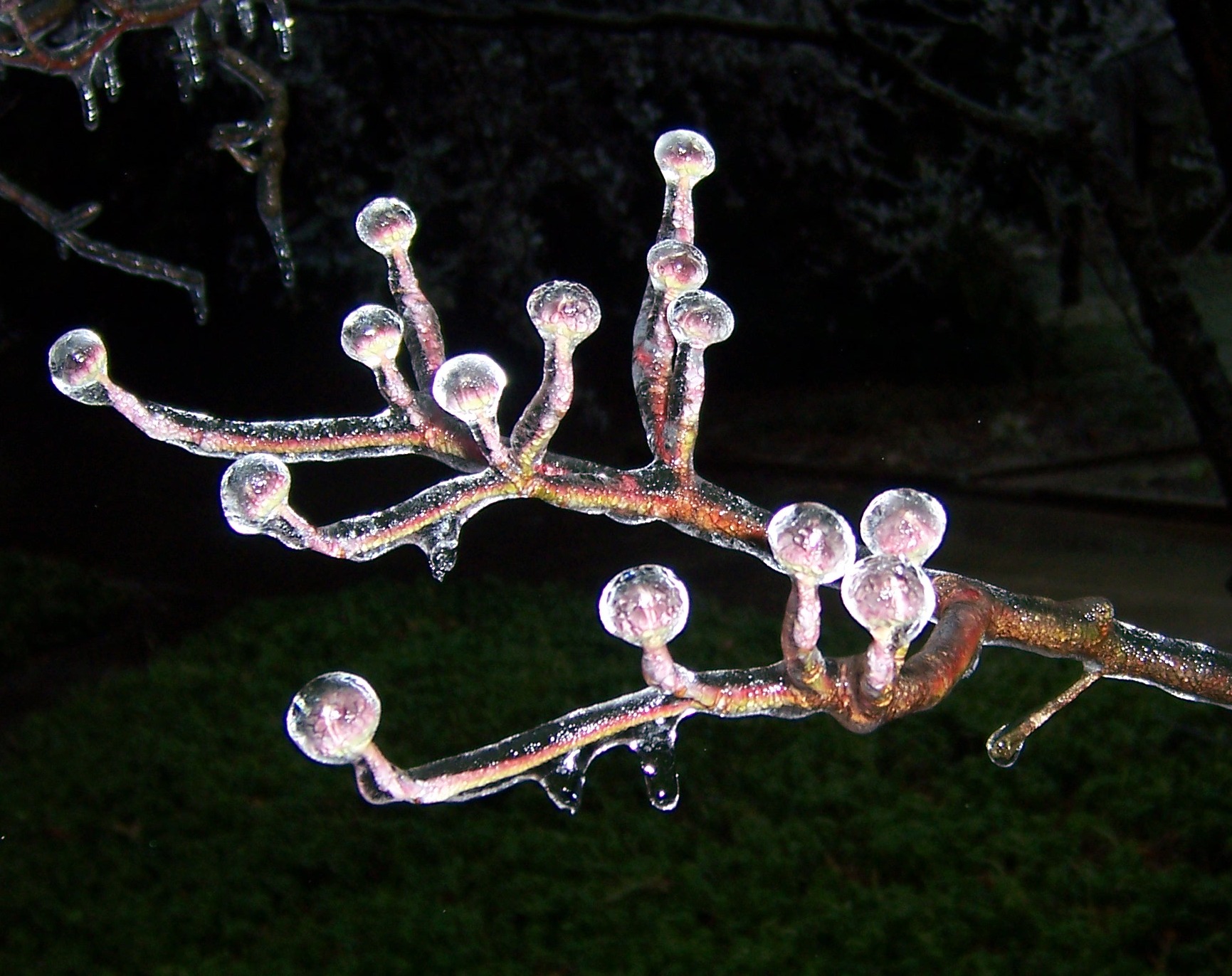
- In the event of an ice storm, allow ice to melt off plants if possible.
If ice has broken a limb, go ahead and remove the branch to reduce further injury or tearing of the bark.
- Check on bulbs that you may have lifted, like dahlias, gladioloas, or cannas. Remove any rotting bulbs.
- Feed the birds. Black oil sunflower seeds will attract lots of different birds. Clean and refill feeders regularly.
FEBRUARY
- Water evergreens if snowfall has been minimal this winter.
- Cut back ornamental grasses before they begin to grow in March.
- Mid-month, sow seeds of peas, larkspur, snapdragons outside now. To bloom best, they must sprout and do much of their growing well before warm weather arrives.
- If you need to control mites or scale insects, pick a warmish day above freezing to apply a dormant oil spray to your ornamental trees and shrubs.
- Start onion seed during the first week of February, start broccoli, cabbage, and cauliflower seeds indoors during the 3rd and 4th week of February.
- Start parsley and thyme seed this month as they take a long time to make a decent-sized transplant. Soak parsley seeds in water for 24 hours prior to planting.
- Collect scion wood from apple and pear trees. This is also the time to prune those trees. Store scion wood in moist paper towels or newspaper then seal in a plastic bag and put in the refrigerator until grafting time comes. Apples should not be in the same refrigerator as scion wood.
- Fertilize fruit trees.
- Repot rootbound houseplants. Choose a new container that is only an inch or 2 larger in diameter than the old container.
- Try forcing some cut woody stems like forsythia, pussy willow, pear, quince, crabapple, or cherry.

Check out the classes and other activities going on at the Pulaski County Cooperative Extension Service office!
Friday, November 05, 2010
Fall Images from the Extension Office Gardens
 Redosier dogwood (red-twig dogwood)
 Carolina sweetshrub
 Nikko Blue hydrangea on left, Annabelle on right
 American beautyberry
 American beautyberry fruit
 Asian species of beautyberry, fruits are much more prominent than the American!
Tuesday, August 10, 2010
Put Pruning Equipment Away
It's the time of year when I begin highly discouraging the use of pruners, loppers, saws, or any other implement used to cut woody plants. I usually tell people to just forget about pruning trees or shrubs from about the middle of August through leaf drop.
The why, if you think about it, is quite logical. Pruning sort of re-invigorates the plant. Makes the plant want to send out new shoots. If a little new shoot emerges below a pruning cut that's made September 1, it usually won't have time to produce wood and harden off completely before our first frost (about October 15). That makes for a dead little shoot.
Unfortunately, this dead shoot can then be the entryway for rotting organisms, like fungi or bacteria. Once they're in, they're in. And the rotting will begin.
The link above is UK's publication called 'Pruning Landscape Trees'. Here's the link to another called 'Pruning Landscape Shrubs'.
The why, if you think about it, is quite logical. Pruning sort of re-invigorates the plant. Makes the plant want to send out new shoots. If a little new shoot emerges below a pruning cut that's made September 1, it usually won't have time to produce wood and harden off completely before our first frost (about October 15). That makes for a dead little shoot.
Unfortunately, this dead shoot can then be the entryway for rotting organisms, like fungi or bacteria. Once they're in, they're in. And the rotting will begin.
The link above is UK's publication called 'Pruning Landscape Trees'. Here's the link to another called 'Pruning Landscape Shrubs'.
Tuesday, May 04, 2010
What's NOT to Like Here....
Look at this tree and tell me one good reason NOT to plant it.


Just some facts first:


Just some facts first:
- It will not grow into power lines.
- It has survived the drought of 2007 and 08 with no supplemental water
- It has fantastic white, fragrant blooms
- It has close to no disease or insect problems
- It is a native plant
- Michael Dirr states that '...I would like to make a case for this as the national shrub for even dogwood does not carry itself with such refinement, dignity, and class when in flower' -- WOW!
Monday, May 03, 2010
The Great Flood of 2010
We're living through it. And your gardens (and maybe basements) had to withstand the deluge. Thank goodness, we didn't have a BUNCH of vegetables out yet. However, here's a bit of advice, gleaned from Rosie Lerner, Extension Consumer Horticulturist from Purdue University:
For those who have actually had a chance to put in early cool-season crops, the issue of food safety from the garden is best handled with caution. Clearly, if floodwaters are contaminated with raw sewage, it is risky to eat the produce. Crops that can be washed thoroughly, peeled and/or boiled should pose minimal risks. However, crops that are eaten uncooked, especially leafy crops such as spinach and lettuce, will be more risky for consumption since it is so difficult to remove all of the contamination with just plain rinsing.
Newly planted seeds and transplants may not survive even short-term flooding, and seeds may have washed away. Resist the urge to replant immediately; give the soil a chance to dry out first. Working wet soil will have long-lasting effects of soil compaction.
As for landscape trees and shrubs, it is difficult to say what the long-term effect of being underwater will be. When soils are completely flooded, oxygen is prevented from reaching the root system. Certainly, some trees are more tolerant of waterlogged conditions, but the longer the lack of aeration, the greater the chance of root death. The general thought is that most landscape plants can survive being submerged for about a week or so. However, extended lack of aeration to the roots will result in root die-back, with the above-ground symptoms appearing as leaf yellowing, droopy foliage, leaf drop and, eventually, branch die-back. Waterlogged root systems are also more susceptible to attack by root-rot organisms. In areas of severe flooding, concerns for plant health also include soil erosion and deposits of additional soil and silt. Both can damage the root system.
In addition to the obvious damage to plants, there are more long-term effects to soils, which have been flooded for extended periods. Soil microorganisms that require oxygen may be killed and those that survive without oxygen take over, which in turn affects availability of nutrients for plant use. The soil structure itself may be physically harmed due to compaction of soil particles.
There isn't much you can do other than wait for drier weather to prevail and allow water to drain. As more favorable conditions return, watch for signs of die-back, but don't be too hasty to cut limbs. Branches that have lost leaves aren't necessarily dead; even though leaves may drop, there may be buds that will be able to re-leaf yet this summer. Live stems and buds will have some green tissue visible. Remove only those limbs that are physically damaged or obviously dead. A light fertilization may be helpful to replace nutrients that were lost and to encourage re-growth.
We may not know the full effect of flooding until long after the water recedes. And then, of course, a lot will depend on what future stresses the weather may bring upon our landscapes.
Subscribe to:
Posts (Atom)