- Weeping Norway spruce – living waterfall, yr-round interest, up to 15' tall
- Miyabe maple – small (up to 40’) tree, dense shade, yellow fall color, fruit produced in fall
- Winterberry holly – deciduous holly, needs male pollinator, up to 15’, bees
- Arrowwood viburnum – durable, adaptable, blue or black fruit, 6 to 15’ tall
- Weeping katsura – up to 25’ tall, Asian tree, redbud-like leaves, full sun to part-shade
- ‘Rozanne’ Geranium – cranesbill geranium, makes 18” mound, purple-blue blooms June to frost
- Trident maple -- up to 35’ tall, tolerates everything you can throw at it, red/yellow fall color, exfoliating bark
- Weeping beech – up to 60’ tall, smooth bark, interesting form, esp winter,
- Buttonbush – native, leggy shrub up to 10-15’ tall, bloom is curious, white and round, attracts pollinators & butterflies
- ‘Fireworks’ goldenrod – clump-forming, non-invasive goldenrod, 3-4’ tall, attracts pollinators
- Persian ironwood – nice, small tree, very attractive bark, yellow/orange/red fall color, red late-winter blooms
- Fothergilla – magnificent shrub, early white bloom, cultivars give reliable orange/red/yellow fall color, blue-green leaves, ‘Mt Airy’
- Sweet birch – native, 40-55’ tall, best fall color (yellow) of all birches, attractive, dark, shiny, bark, bruised stems emit wintergreen odor
- Blazingstar – there are several and they are native, reliable, summer-blooming perennials that pollinators adore.
- Butterflyweed or swamp milkweed – for the monarchs, these 2 are the showiest and least invasive
- Green Panda Bamboo – not invasive, 6-8’ tall and equal width, protect from pm sun, used as single plant or hedge.
- Kentucky coffeetree – native, KY Heritage Tree, large tree, suckers from root, male selections (no pods), dappled shade.
- Blackgum – native, red fall color, 30-50’ tall, blue-black berries, glossy foliage, v.good honey tree
- Purple Beautyberry – small shrub up to 5’ tall, most graceful of the beautyberries, metallic purple berries, also a white-berried selection.
- Bottlebrush buckeye – part-shade to sun, suckering shrub, excellent foliage and flowers (white spikes), 10’ tall
- Paperbark maple – trifoliate-leaved, cinnamon-brown exfoliating bark, orange-red fall color, 20-30’tall
- Nordman fir – heat-tolerant, well-drained soils, 40-60’ tall, soft needles, conical evergreen, weeping & prostrate forms
- Baptisia – white, purple, and yellow forms, some cultivars, perennial with 4 season appeal, handsome foliage, flowers, seedpods
- Burkwood viburnum -- superior selection ‘Mohawk’, ornamental red flower buds precede fragrant white flowers, 7’tall and wide
- Fringetree – small, native tree 15-20’ tall, white fragrant blooms, unrivaled when in full bloom, blue berries
Showing posts with label winter. Show all posts
Showing posts with label winter. Show all posts
Friday, December 26, 2014
December's 25 Days of Superior Trees, Shrubs, and Perennials
People love lists. I love lists. So when December 1st rolled around, I made a decision to put together a list of trees, shrubs, and perennials for each of the days leading up to Christmas. So here you go:


Wednesday, December 04, 2013
Gardening in the Winter? Yep.
Although 'gardening' is probably not an activity many people think of in the winter, here are some gardening-like things to do while stuck in the doldrums of winter:
DECEMBER

JANUARY
FEBRUARY
Check out the classes and other activities going on at the Pulaski County Cooperative Extension Service office!
DECEMBER

- Always keep a watering can full of water so that the water can be at room temperature. Don't shock your houseplants by watering with cold water.
- When bringing poinsettias from the greenhouse to the car and the car to the house, be sure to protect them from the cold. They do NOT like the cold, not one bit.
- If you have some hollies with berries, prune some to bring inside for decoration
- If you planted a tree this fall, be sure to mulch it. It's really important.
- Fresh cut Christmas trees last longer and pose less fire hazard if you keep them well-watered while in the house.
- Clay pots that look like this can be soaked in a mixture of 1 gal water: 1 cup bleach: 1 cup vinegar. Soak them overnight then scrub the crud off.
- Wash the dust off houseplants.
JANUARY
- Seed time! Start germination tests on old seeds by wetting a paper towel. Place 10-20 seeds on the wet towel, fold or roll it up and place in a ziplock bag. Remember to label the bag with seed name, cultivar or variety name, and the date you started the germination test. Place these in ambient temperatures and check weekly (or sooner). Poorly germinating seeds can then be discarded.
- Consider purchasing a heating mat for germinating seeds. This cuts germination time for many species in half and gets you a jump on things (especially if you run behind like I do).
- For insect pests like mealybugs or whiteflies, you can spray insecticidal soap on houseplants. Be sure to get very thorough coverage of the insecticide for best results.
- In the event of an ice storm, allow ice to melt off plants if possible.
If ice has broken a limb, go ahead and remove the branch to reduce further injury or tearing of the bark.
- Check on bulbs that you may have lifted, like dahlias, gladioloas, or cannas. Remove any rotting bulbs.
- Feed the birds. Black oil sunflower seeds will attract lots of different birds. Clean and refill feeders regularly.
FEBRUARY
- Water evergreens if snowfall has been minimal this winter.
- Cut back ornamental grasses before they begin to grow in March.
- Mid-month, sow seeds of peas, larkspur, snapdragons outside now. To bloom best, they must sprout and do much of their growing well before warm weather arrives.
- If you need to control mites or scale insects, pick a warmish day above freezing to apply a dormant oil spray to your ornamental trees and shrubs.
- Start onion seed during the first week of February, start broccoli, cabbage, and cauliflower seeds indoors during the 3rd and 4th week of February.
- Start parsley and thyme seed this month as they take a long time to make a decent-sized transplant. Soak parsley seeds in water for 24 hours prior to planting.
- Collect scion wood from apple and pear trees. This is also the time to prune those trees. Store scion wood in moist paper towels or newspaper then seal in a plastic bag and put in the refrigerator until grafting time comes. Apples should not be in the same refrigerator as scion wood.
- Fertilize fruit trees.
- Repot rootbound houseplants. Choose a new container that is only an inch or 2 larger in diameter than the old container.
- Try forcing some cut woody stems like forsythia, pussy willow, pear, quince, crabapple, or cherry.

Check out the classes and other activities going on at the Pulaski County Cooperative Extension Service office!
Monday, February 01, 2010
Cold Outside (and stay that way!)
Over the past 3 days, I've seen the temperature at 4F and 5F on Saturday and this morning, respectively. We've got 3 outside cats who amaze me at their toughness. We built them a cathouse out of leftover insulating panels. We also make sure they have a fluffy old comforter inside their cathouse. In the mornings when I feed them, they saunter out of their house and feel warm to the touch.
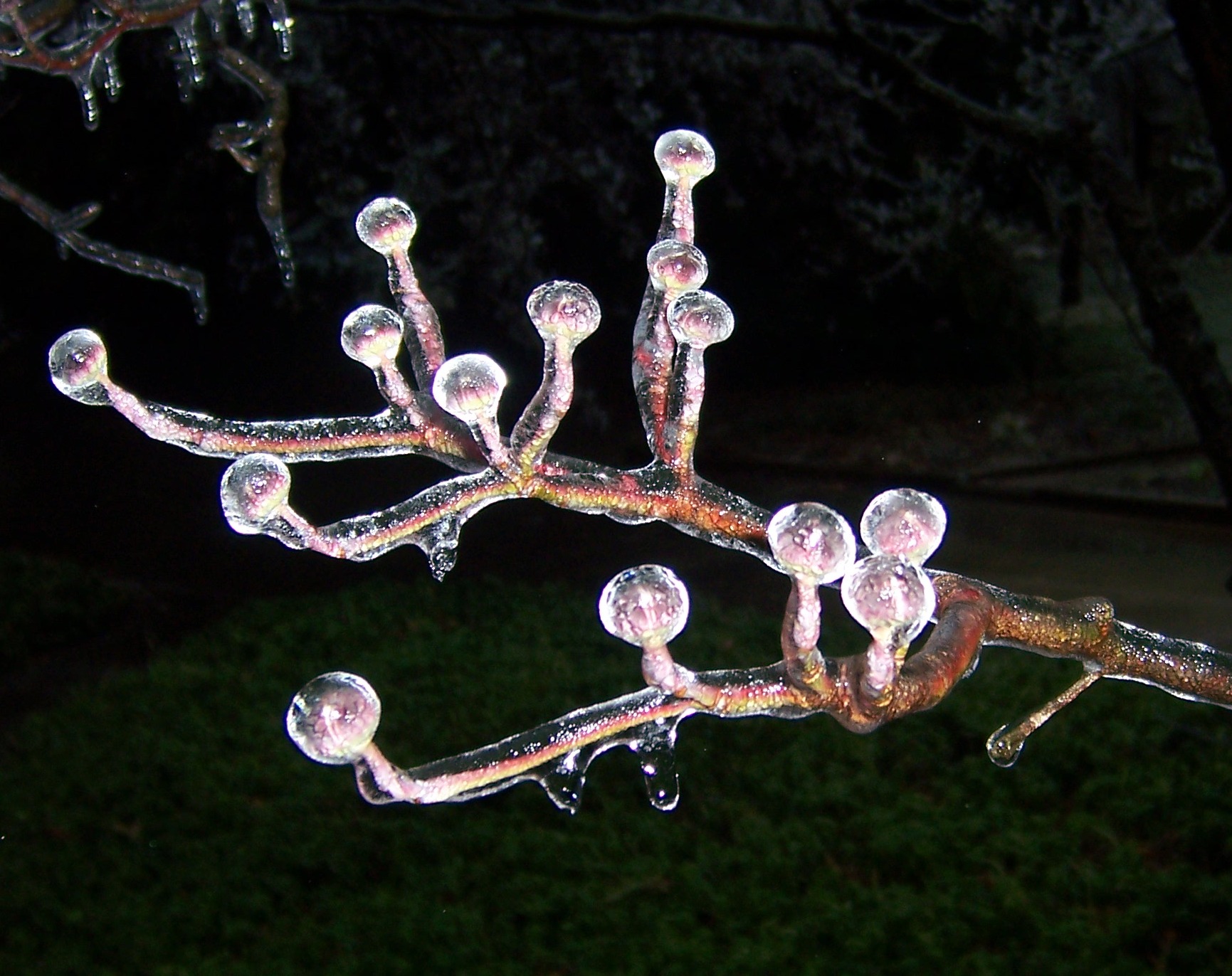
Cats amaze me at how they handle the cold. And birds (we feed a bunch of them). But my plants do too. And they aren't provided anything to protect them. I took some shots of the ice that enveloped the bark and buds of some of my trees and shrubs over the weekend.
 Here's my yellowood (Cladrastis kentuckea) bud encased in ice.
 The bark of my young catalpa is frost-covered too.
January has been great (cold, I know, but great) since we haven't had any warm-ups. If we get some abnormally warm days, trees and shrubs can be tricked into growing. Remember April 2007?
As much as I hate to say it, I kinda hope it stays cold through February.
Friday, December 11, 2009
Very Nippy Night
At about 6:15 am this morning, my thermometer read 5 degrees. That's cold. It took that kind of a night to finally kill (or at least maim) the artichokes (pictured below) and the chard I had planted earlier this year. The thyme doesn't look like it's been hurt at all.


Our small fountain is pretty but the I'm sure the pump is toast.


And lastly, the contorted filbert (Corylus avellana 'Harry Lauder') is really showing off at this time of the year.


Our small fountain is pretty but the I'm sure the pump is toast.


And lastly, the contorted filbert (Corylus avellana 'Harry Lauder') is really showing off at this time of the year.
Subscribe to:
Posts (Atom)