Monday, December 24, 2012

12 New Trees and Shrubs


In honor of 12/12/12 a couple of weeks ago, I'm rounding out my '12 New _____ Plants' to try during 2013 with a list of trees or shrubs.  You can see the other two 12-lists by scrolling down.

12 New or Different Trees or Shrubs to try in 2013
  1. Yellowwood -- a spring-flowering, overlooked native plant, yellowwood was featured in the UK College of Ag's AgMag this fall.
  2. Cryptomeria (Japanese cedar) -- makes a great screen plus it's different!  Try it!
  3. Green Panda Bamboo TM -- a great non-invasive bamboo
  4. Buttonbush -- thrives in wet areas but grows very well in non-soppy areas too
  5. Goldenraintree -- not my favorite but it's easy and different and not at all a bad plant
  6. Lacebark pine -- what's not to like? It's a pine AND it has exfoliating bark.
  7. Ginkgo -- get a male cultivar like 'Autumn Gold' but there are others
  8. Doublefile Viburnum -- impresses me more and more each time I see one.
  9. Chastetree -- interesting compound leaves (remind you of marijuana), provides purple blooms June/July through frost and the bees love it!
  10. Japanese zelkova -- this is just a good street tree, very tolerant of urban conditions. In Somerset, these can be seen more around businesses but they lend themselves well to just being in someone's yard as a shade tree.
  11. Fothergilla -- I just love these plants. Extremely nice fall color, wonderful spring blooms.
  12. Virginia sweetspire -- if you need a plant to fill in an area in 3 to 4 years, with white bottebrush blooms and red fall color, you want this one. 'Little Henry' is a good dwarf selection.


Doublefile viburnum


Dwarf fothergilla

Green Panda bamboo       


Tuesday, December 18, 2012

12 New Annuals

In honor of last week's date of 12/12/12, in this 2nd week, we'll be talking about 12 new annuals/perennials for home landscapes.  Last week I listed 12 fruits and vegetables.

12 New or Different Annuals and Perennials to try in 2013
(A) designates annual, (P) perennial
  1. Amaranth -- 'Love Lies Bleeding' is very cool. And if you want some art in the garden, try the very sculptured-looking 'Elephant Head' (A)
  2. Hyacinth bean -- need a vine for summer/fall only to block that western sun? Grow this lovely plant with very cool-looking seeds. Even dried pods look good. (A)
  3. Black-eyed Susan -- these have been around forever, but they perform! 'Indian Summer' is a good choice, 'Goldilocks' is a double. (P)
  4. Zinnias -- these just make me smile, remind me of my grandmother. They are easy and will self-sow somewhat. Butterflies love them. Profusion or Zahara series are recommended. (A)
  5. Ornamental peppers -- my fave 'Numex Twilight', but so many others like 'Black Pearl' and the miniature 'Medusa' (A)
  6. Sunflowers -- I know they're popular, but try some of the pollenless varieties. And remember to bring them inside so you can admire them. (A)
  7. Sun coleus (A)
  8. Papyrus -- 'King Tut' or 'Baby Tut' love water and were used at the Children's Garden & here at our office in containers. Brings some interesting texture to the garden. (A)
  9. Any Liatris (blazingstar) (P)
  10. Any Baptisia (false blue indigo) -- a misnomer now since there are yellow varieties of this (P)
  11. Bulbs -- ornamental alliums, daffodils, species tulips, or lilies are recommended (P)
  12. Japanese anemone -- these late summer and fall bloomers are overlooked way too much. Team it up with some asters and you've got a great display (P)
You'll notice that some of these are old, really old.  But they're still good.

Amaranth, Elephant Head FLOWER 0.15 g - Click Image to Close
Elephant Head amaranth


Hyacinth bean


'King Tut' papyrus
Numex Twilight ornamental pepper

Japanese anemone

Wednesday, December 12, 2012

12/12/12 -- Let's Do 12 New Plants!

On this unique date, let's use it to think about 12 new varieties of vegetables/fruit (today), 12 new varieties of annuals (week of Dec 17), and 12 new types of trees or shrubs (week of Dec 24) for our landscapes.

12 New or Different Vegetables or Fruits to try in 2013
  1. Sprouting broccoli
  2. Shell beans -- I know that beans are one of the cheapest things in the store, but you can't buy Vermont Cranberry beans or Pawnee shell beans at the grocery.
  3. Carrots -- if you think you know what carrots taste like, grow them yourself and be amazed! Try different varieties like 'Purple Haze' or 'Atomic Red'.
  4. Popcorn or cornmeal corn (why not?)
  5. Eggplant -- there are more uses for eggplant than you think, so try it.  They are beautiful as well, varying shapes and sizes.
  6. Snap, snow, or shelling peas -- easy and done by the end of May. Pretty flowers
  7. Fall bearing blackberries &/or raspberries -- Prime ARK 45 (black), Caroline or Heritage (rasp). Easy pruning.
  8. Snacking peppers -- they're small, colorful, and extremely sweet. Johnny's Seed calls them 'Lunchbox Peppers
  9. Blueberries -- soil test first but they are super healthy and easy to grow once soil conditions are correct.  New pink varieties like 'Pink Lemonade', 'Tophat' for containers (oh, and you'll need two varieties)
  10. Garlic -- so easy, just do it.
  11. Cilantro -- either the flat leaf that looks like parsley or try 'Delfino'
  12. Corn salad or mache -- this was Thomas Jefferson's favorite green. Grow it and see why.

Mache (from Johnny's Seed)

Item Photo
Pawnee shell bean (from Seeds of Change)
Orient Charm (F1)
Orient Charm (from Johnny's Seed)

Tuesday, November 13, 2012

Daffodils

I will be the first to admit, daffodils are not my favorite flower.  In fact, I'm not sure how I would answer that question anyway, but it would not be with 'daffodil'.

But I am now addicted.  To daffodils.  Daffs, as the familiar call them.

But I can't afford them, at least not in the amounts I'd like.  So, as with some addictions, I'll take my daffs in small, annual doses.

Have you ever heard of the cyclamineus types of daffs?  They are distinctive because of their reflexed perianth segments (say that 3 times fast).  Here's one called 'Beryl':


And how about the jonquilla group? Heard of them?  Daffs in this group have multiple flowers per stem. Yes, multiple. And they have a fragrance!  Look at this one called 'Blushing Lady':


And there are the Poets (poeticus group).  They are distinguished by a spicy fragrance and dogwood-like bloom, this one is called 'Actaea':


There are so many more.  The miniatures, the doubles, the large cups, the small cups, the split-collars. And 99.99% of them are perfectly hardy in our Zone 6. 

So, get moving, as daffs like these are selling out quickly. The Children's Garden at the Pulaski County Library and the Pulaski County Extension office gardens will be blooming next spring with some of these wonderful daffs!

** pictures come from Brent and Becky's Bulbs website https://store.brentandbeckysbulbs.com/
** more information can be found at the American Daffodil Society

Friday, September 28, 2012

Rain Gardens

It was raining this morning, so I thought I might do a post on rain gardens.  Makes sense at 5:15am....

A rain garden is a strategically located low area planted with (usually) native plants that intercepts runoff from rain events and allows it to infiltrate the soil.

Just think of all the paved areas we have...rain will not penetrate into soil but is directed into storm sewers where this unfiltrated water is either redirected through waste water treatment or goes directly into lakes, ponds, or streams.  I don't know about you, but I see some gross stuff on pavement.  Not only oil and other car or truck leakages but roadkill, trash, etc.

A city block will shed 9 times more runoff than a wooded area of similar size.

Rain gardens will:
  • increase the amount of water that infiltrates the soil to recharge aquifers
  • help protect communities from flooding and drainage problems
  • help protect streams and lakes from pollutants carried by runoff
  • protect against the negative effects of impervious surfaces created by development
  • enhance neighborhood beauty
  • provide wildlife habitat (birds, bees, and butterflies)
All construction isn't bad I realize, but better builders may consider permeable pavement in parking lots or sidewalks. 

For more information, click here.

Pulaski County will be getting a rain garden in the spring of 2013 and the public will be invited to attend to learn how to situate and construct one of these.  Should be fun.

Thursday, July 19, 2012

Potato Harvest for Home Gardeners

At the office, I planted potatoes using a couple of different methods a home gardener might try.

One was the square foot gardening method where I planted potatoes in 2 squares side-by-side.  I used the 'high-rise' method where I built another 1' x 2' x 6" square so that I could add more soil as the potatoes grew.  In total, the square foot gardening method gave me about 12" of depth in which potatoes could form.

5/23/12, about 8 weeks of growth
The other method of raising potatoes was using a grow bag.  I had 2 different colors of these bags (which cost me $20 each).  With this method, you fill up the bag, eventually to the top, as the potato grows. 

4 seed pieces per square planted 3/28/12
Kennebec potatoes were planted on 3/28/12.  Four seed pieces went in each square of the square foot garden and 8 seed pieces were planted into each grow bag. So each method was planted with equal numbers of seed pieces.


8 seed pieces were planted in each bag 3/28/12


So, here's what the plants looked like prior to harvest:


Square foot garden 7/17/12
Tan bag 7/17/12


Black bag 7/17/12

 And here's the harvest 16 weeks after planting:
Left sq ft garden, middle black bag, right tan bag

Pure numbers tell us that the 2 squares of the square foot garden produced the best, yielding 19 potatoes weighing 4.05#.
The black bag ended up producing a lot of little tubers (23 total) weighing in at 2.69#.
The tan bag produced the least (13 tubers in all) weighing 2.13#.

The best quality is dependent on whether you like new potatoes over baking or slicing sized potatoes.  For new potatoes, the black bag produced more smaller ones.  However, I would say the best overall was the sq ft garden harvest.

I suspect that in a 'normal' year (whatever that is) overall, plants would have yielded more.  With temps in the 100s for a week or more, tubers will not (and did not) size up. I suspect that perhaps the medium in which the tubers were forming was cooler in the sq ft garden bed than in the grow bags.  However, I did not measure the temperature.

Happy gardening!


Monday, July 16, 2012

Blister Beetles Now Appearing

Blister Beetles Appearing

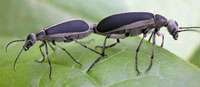
Blister beetle 
Margined blister beetles

Blister beetles can be quite a sight in the home garden.  About this time of year, their populations build up to incredible numbers.  They amass on and can defoliate plants in a day or two if the infestation is severe enough. They seem to prefer plants in the Solanaceous family like tomatoes, eggplant, and peppers.


Beetles are about a half-inch long.  Their name comes from the defensive chemical, a blistering agent, that is released when they are handled or disturbed. These insects are most active in the morning and late afternoon and may disappear during the hottest part of the day. They are easily disturbed and will drop off the plant or run away if disturbed.

The striped blister beetle has a yellow-orange head and body with three long black stripes running along each wing cover. It will feed on many different vegetables but seems to prefer the fruits of solanaceous plants. They also are foliage feeders with big appetites. Striped blister beetles form large mobile feeding masses so they can descend on an area and cause a lot of damage in a short time. Other species in the area include the black blister beetle and the margined blister beetle. The latter has a black body with thin gray stripes along the wing covers and a gray abdomen. These two species frequently feed on flowers, the black blister beetle can be found on alfalfa flowers.

Pyrethroid products work well against blister beetles.  Neem may be of help as a feeding deterrent.  Organic controls include Neem, spinosad products, and shaking the beetles into soapy water.

Blister beetles can kill horses. For more information, http://www.ca.uky.edu/entomology/entfacts/ef102.asp