Wednesday, December 04, 2013

Gardening in the Winter? Yep.

     Although 'gardening' is probably not an activity many people think of in the winter, here are some gardening-like things to do while stuck in the doldrums of winter:

DECEMBER
  • Always keep a watering can full of water so that the water can be at room temperature. Don't shock your houseplants by watering with cold water.
  • When bringing poinsettias from the greenhouse to the car and the car to the house, be sure to protect them from the cold. They do NOT like the cold, not one bit.
  • If you have some hollies with berries, prune some to bring inside for decoration
  • If you planted a tree this fall, be sure to mulch it.  It's really important.
  • Fresh cut Christmas trees last longer and pose less fire hazard if you keep them well-watered while in the house.
  • Clay pots that look like this can be soaked in a mixture of 1 gal water: 1 cup bleach: 1 cup vinegar.  Soak them overnight then scrub the crud off.  
  • Wash the dust off houseplants.

JANUARY
  •  Seed time! Start germination tests on old seeds by wetting a paper towel. Place 10-20 seeds on the wet towel, fold or roll it up and place in a ziplock bag.  Remember to label the bag with seed name, cultivar or variety name, and the date you started the germination test. Place these in ambient temperatures and check weekly (or sooner). Poorly germinating seeds can then be discarded.
  • Consider purchasing a heating mat for germinating seeds.  This cuts germination time for many species in half and gets you a jump on things (especially if you run behind like I do).
  • For insect pests like mealybugs or whiteflies, you can spray insecticidal soap on houseplants.  Be sure to get very thorough coverage of the insecticide for best results.
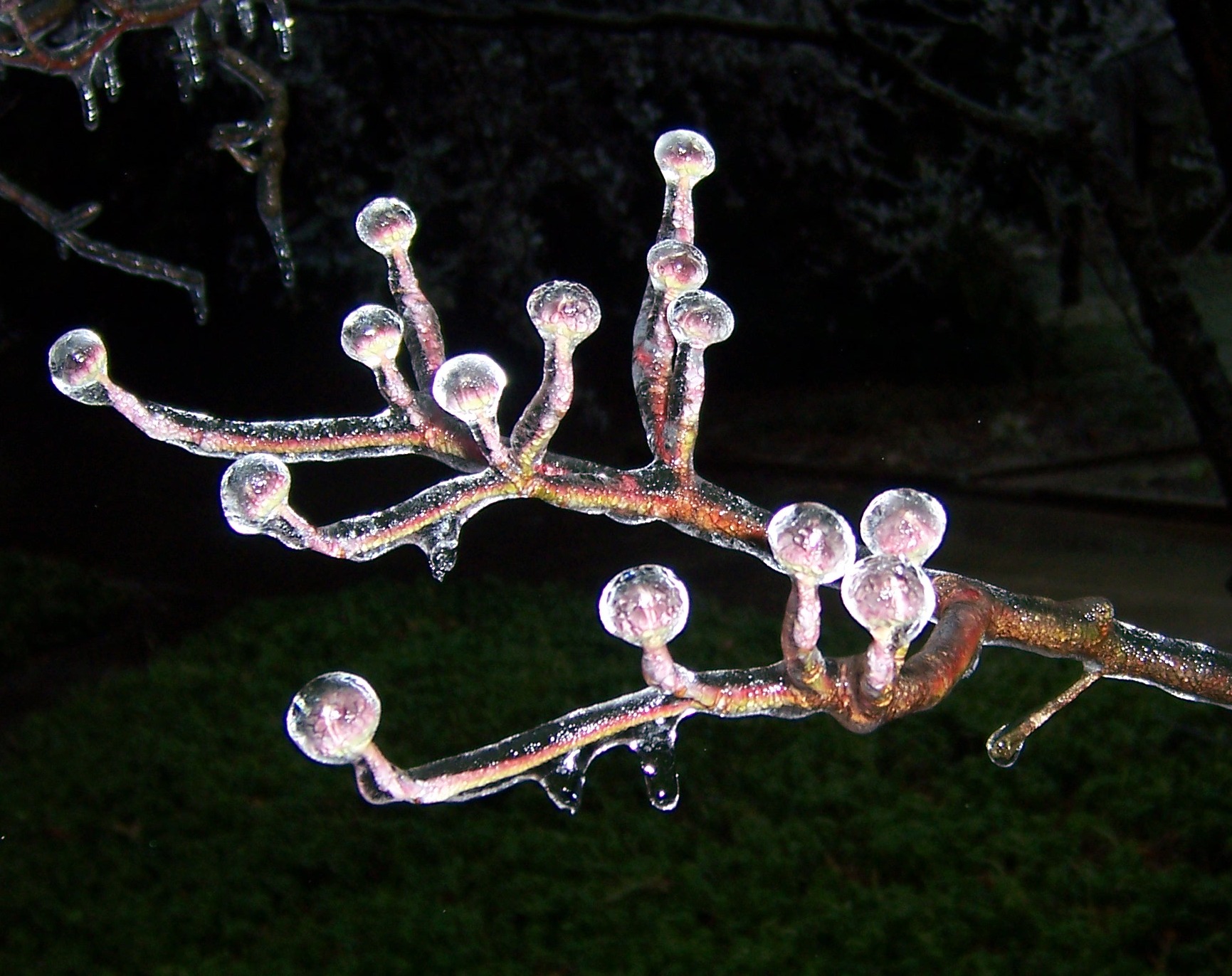
  • In the event of an ice storm, allow ice to melt off plants if possible.  If ice has broken a limb, go ahead and remove the branch to reduce further injury or tearing of the bark.
  •  Check on bulbs that you may have lifted, like dahlias, gladioloas, or cannas. Remove any rotting bulbs.
  • Feed the birds.  Black oil sunflower seeds will attract lots of different birds. Clean and refill feeders regularly.
FEBRUARY

  • Water evergreens if snowfall has been minimal this winter.
  • Cut back ornamental grasses before they begin to grow in March.
  • Mid-month, sow seeds of peas, larkspur, snapdragons outside now.  To bloom best, they must sprout and do much of their growing well before warm weather arrives.
  • If you need to control mites or scale insects, pick a warmish day above freezing to apply a dormant oil spray to your ornamental trees and shrubs.
  • Start onion seed during the first week of February, start broccoli, cabbage, and cauliflower seeds indoors during the 3rd and 4th week of February.
  • Start parsley and thyme seed this month as they take a long time to make a decent-sized transplant. Soak parsley seeds in water for 24 hours prior to planting.
  • Collect scion wood from apple and pear trees.  This is also the time to prune those trees. Store scion wood in moist paper towels or newspaper then seal in a plastic bag and put in the refrigerator until grafting time comes. Apples should not be in the same refrigerator as scion wood.
  • Fertilize fruit trees.
  • Repot rootbound houseplants.  Choose a new container that is only an inch or 2 larger in diameter than the old container.
  • Try forcing some cut woody stems like forsythia, pussy willow, pear, quince, crabapple, or cherry.  Pussy Willow


Check out the classes and other activities going on at the Pulaski County Cooperative Extension Service office! 

Tuesday, July 16, 2013

Fall 2013 Master Gardener Program

     Many people have a love for things that grow.  If you have that love as well as a love for community service, then the Master Gardener Program may be right for you.  The program will be held in Pulaski Co this fall 2013.  The fee is $150.  You must fill out a Master Gardener application.  Rough starting dates are early to mid-September through mid-December.  This is the classroom portion of the training.
     After passing a test at the end of the classroom training, participants have 12 months to volunteer 40 hours back to the community.  The Lake Cumberland Master Gardener Association was formed as a way to communicate to members what is going on in the community as well as be a social, friendly place to meet and greet like-minded folds.  They meet monthly except for July and August.
     During the classroom training, program participants learn about botany, soils and fertilizers, entomology, plant pathology, pesticide safety, annuals and perennials, vegetables, woody plants, fruits, turf, organic gardening, and a few other topics.  We meet for 3 hours each week.
     You will receive the Kentucky Master Gardener Manual in a 3-ring binder as well as some supplemental resources. Classes are taught by Kentucky Horticulture Agents and UK Specialists.
     Projects Master Gardeners are involved in include their annual Pulaski County Garden Tour, the Children's Garden at the Pulaski County Public Library, city and county beautification efforts, marketing the program at various events (like Earth Day celebrations), and even writing newsletter articles.  There are many other opportunities as well.
     I hope several of you decide to go through the program.  I think most participants get a lot of gratification from it.  
    If you need more information, come to a meeting about the program on July 25, 2013 at 6pm at the Pulaski County Extension office.  If you cannot make it but still have questions, you can email Beth Wilson or call the office 606-679-6361.

Friday, January 18, 2013

Old Seeds and Jack (you have to read to the end)

This is not a post about doing germination tests on your old flower or vegetable seeds.  This is a story of forgetfulness.

Back in the fall of 2010, I was hiking at the Yahoo Falls area in McCreary Co, KY.  Great place to hike by the way.  I collected some seed from a cucumber magnolia.  I absolutely love our native deciduous magnolias!  I gathered between 15 and 25 seeds.

When I got home, I did the thing that all horticulturists know to do with those temperate woody tree seeds, and that's stratify them.  In order to germinate, these guys have to go through a cool, moist period of a certain length.  Only after that will the seeds germinate.

So, as a good horticulturist, I got my ziplock bag and filled it with moist vermiculite, stuck my seeds in, and crammed them in the back of my fridge.  Never to be looked at until again December of 2012.

That does tend to happen...forgetting what you've stuck in the fridge, especially waaaay in the back.

I found the bag, inspected the contents, and the seeds had indeed germinated in the bag.  That was expected.  I gently tugged the individual plants out. The root systems weren't any longer than maybe 2" and some were nicely branched and white as can be - a healthy root.  The seed case still enclosed the cotyledons.

I didn't have much hope that those cotyledons would be intact. I figured they'd be rotted.  Anyway, I potted up 6 of the most promising little seedlings. I watched them green up (they were little albinos in the bag). I watched them bend toward light sources.  But the seed cases were hanging on and wouldn't release the cotyledons.

Two seedlings a day or 2 on the counter after their 2-year stint in the fridge
 
So, I opened them up by hand. They were a little crispy, somewhat hard.  I messed up one of the plants, tore the whole plum thing off.  But the other 5 look promising.

The most promising seedling, you can see its first true leaves between the cotyledons
Ragged cotyledons on another 2 seedlings, but I have high hopes
The cotyledons aren't terribly pretty, a little ragged.  In two of the 5, I even see very, very small first true leaves!  I feel like a proud mama (who neglected her children for 2 years)!  But I think they're going to be OK. I truly don't know why I even gave them a shot, I normally would have just thrown the bag with the seeds out after being in the fridge that long.

Just goes to show you, when you think you know it all about plants, you don't know jack.

Monday, December 24, 2012

12 New Trees and Shrubs


In honor of 12/12/12 a couple of weeks ago, I'm rounding out my '12 New _____ Plants' to try during 2013 with a list of trees or shrubs.  You can see the other two 12-lists by scrolling down.

12 New or Different Trees or Shrubs to try in 2013
  1. Yellowwood -- a spring-flowering, overlooked native plant, yellowwood was featured in the UK College of Ag's AgMag this fall.
  2. Cryptomeria (Japanese cedar) -- makes a great screen plus it's different!  Try it!
  3. Green Panda Bamboo TM -- a great non-invasive bamboo
  4. Buttonbush -- thrives in wet areas but grows very well in non-soppy areas too
  5. Goldenraintree -- not my favorite but it's easy and different and not at all a bad plant
  6. Lacebark pine -- what's not to like? It's a pine AND it has exfoliating bark.
  7. Ginkgo -- get a male cultivar like 'Autumn Gold' but there are others
  8. Doublefile Viburnum -- impresses me more and more each time I see one.
  9. Chastetree -- interesting compound leaves (remind you of marijuana), provides purple blooms June/July through frost and the bees love it!
  10. Japanese zelkova -- this is just a good street tree, very tolerant of urban conditions. In Somerset, these can be seen more around businesses but they lend themselves well to just being in someone's yard as a shade tree.
  11. Fothergilla -- I just love these plants. Extremely nice fall color, wonderful spring blooms.
  12. Virginia sweetspire -- if you need a plant to fill in an area in 3 to 4 years, with white bottebrush blooms and red fall color, you want this one. 'Little Henry' is a good dwarf selection.


Doublefile viburnum


Dwarf fothergilla

Green Panda bamboo       


Tuesday, December 18, 2012

12 New Annuals

In honor of last week's date of 12/12/12, in this 2nd week, we'll be talking about 12 new annuals/perennials for home landscapes.  Last week I listed 12 fruits and vegetables.

12 New or Different Annuals and Perennials to try in 2013
(A) designates annual, (P) perennial
  1. Amaranth -- 'Love Lies Bleeding' is very cool. And if you want some art in the garden, try the very sculptured-looking 'Elephant Head' (A)
  2. Hyacinth bean -- need a vine for summer/fall only to block that western sun? Grow this lovely plant with very cool-looking seeds. Even dried pods look good. (A)
  3. Black-eyed Susan -- these have been around forever, but they perform! 'Indian Summer' is a good choice, 'Goldilocks' is a double. (P)
  4. Zinnias -- these just make me smile, remind me of my grandmother. They are easy and will self-sow somewhat. Butterflies love them. Profusion or Zahara series are recommended. (A)
  5. Ornamental peppers -- my fave 'Numex Twilight', but so many others like 'Black Pearl' and the miniature 'Medusa' (A)
  6. Sunflowers -- I know they're popular, but try some of the pollenless varieties. And remember to bring them inside so you can admire them. (A)
  7. Sun coleus (A)
  8. Papyrus -- 'King Tut' or 'Baby Tut' love water and were used at the Children's Garden & here at our office in containers. Brings some interesting texture to the garden. (A)
  9. Any Liatris (blazingstar) (P)
  10. Any Baptisia (false blue indigo) -- a misnomer now since there are yellow varieties of this (P)
  11. Bulbs -- ornamental alliums, daffodils, species tulips, or lilies are recommended (P)
  12. Japanese anemone -- these late summer and fall bloomers are overlooked way too much. Team it up with some asters and you've got a great display (P)
You'll notice that some of these are old, really old.  But they're still good.

Amaranth, Elephant Head FLOWER 0.15 g - Click Image to Close
Elephant Head amaranth


Hyacinth bean


'King Tut' papyrus
Numex Twilight ornamental pepper

Japanese anemone

Wednesday, December 12, 2012

12/12/12 -- Let's Do 12 New Plants!

On this unique date, let's use it to think about 12 new varieties of vegetables/fruit (today), 12 new varieties of annuals (week of Dec 17), and 12 new types of trees or shrubs (week of Dec 24) for our landscapes.

12 New or Different Vegetables or Fruits to try in 2013
  1. Sprouting broccoli
  2. Shell beans -- I know that beans are one of the cheapest things in the store, but you can't buy Vermont Cranberry beans or Pawnee shell beans at the grocery.
  3. Carrots -- if you think you know what carrots taste like, grow them yourself and be amazed! Try different varieties like 'Purple Haze' or 'Atomic Red'.
  4. Popcorn or cornmeal corn (why not?)
  5. Eggplant -- there are more uses for eggplant than you think, so try it.  They are beautiful as well, varying shapes and sizes.
  6. Snap, snow, or shelling peas -- easy and done by the end of May. Pretty flowers
  7. Fall bearing blackberries &/or raspberries -- Prime ARK 45 (black), Caroline or Heritage (rasp). Easy pruning.
  8. Snacking peppers -- they're small, colorful, and extremely sweet. Johnny's Seed calls them 'Lunchbox Peppers
  9. Blueberries -- soil test first but they are super healthy and easy to grow once soil conditions are correct.  New pink varieties like 'Pink Lemonade', 'Tophat' for containers (oh, and you'll need two varieties)
  10. Garlic -- so easy, just do it.
  11. Cilantro -- either the flat leaf that looks like parsley or try 'Delfino'
  12. Corn salad or mache -- this was Thomas Jefferson's favorite green. Grow it and see why.

Mache (from Johnny's Seed)

Item Photo
Pawnee shell bean (from Seeds of Change)
Orient Charm (F1)
Orient Charm (from Johnny's Seed)

Tuesday, November 13, 2012

Daffodils

I will be the first to admit, daffodils are not my favorite flower.  In fact, I'm not sure how I would answer that question anyway, but it would not be with 'daffodil'.

But I am now addicted.  To daffodils.  Daffs, as the familiar call them.

But I can't afford them, at least not in the amounts I'd like.  So, as with some addictions, I'll take my daffs in small, annual doses.

Have you ever heard of the cyclamineus types of daffs?  They are distinctive because of their reflexed perianth segments (say that 3 times fast).  Here's one called 'Beryl':


And how about the jonquilla group? Heard of them?  Daffs in this group have multiple flowers per stem. Yes, multiple. And they have a fragrance!  Look at this one called 'Blushing Lady':


And there are the Poets (poeticus group).  They are distinguished by a spicy fragrance and dogwood-like bloom, this one is called 'Actaea':


There are so many more.  The miniatures, the doubles, the large cups, the small cups, the split-collars. And 99.99% of them are perfectly hardy in our Zone 6. 

So, get moving, as daffs like these are selling out quickly. The Children's Garden at the Pulaski County Library and the Pulaski County Extension office gardens will be blooming next spring with some of these wonderful daffs!

** pictures come from Brent and Becky's Bulbs website https://store.brentandbeckysbulbs.com/
** more information can be found at the American Daffodil Society