Showing posts with label pesticides. Show all posts

Monday, July 28, 2014

Emerald Ash Borer in Pulaski Co


     The emerald ash borer has been trapped in far eastern Pulaski County.  Three individuals were trapped at the Bee Rock Campground near the Rockcastle River.  Just because EAB was confirmed here, it's still hard to know how widespread the critter is.
     Specialists at the University of Kentucky recommend treating high value ash trees.  I would certainly concur. Unfortunately, the best time for treating trees is in the spring. So, for now, not much to do.
     What you can do now is this: read up about the pest and its treatment options: http://www.emeraldashborer.info/files/Multistate_EAB_Insecticide_Fact_Sheet.pdf.  Most of us will go with the homeowner option of imidacloprid (Bayer AdvancedTM Tree and Shrub Insect Control or OptrolTM).  If your tree is less than 20 inches in diameter, it can be treated successfully.  It takes 4 to 6 weeks for the pesticide to be taken up and distributed throughout the tree.
PictureEmerald ash borer     Imidacloprid should be applied in mid-March to late April. The rate is dependent on how large the tree is.  If you need help measuring, please let me know as I have a diameter tape that measures trunk diameter.  This treatment will have to be repeated on an annual basis.
    For more information or questions, please don't hesitate to call the Pulaski County Extension Service at 606-679-6361 or email me at beth.wilson@uky.edu 


Monday, July 16, 2012

Blister Beetles Now Appearing

Blister Beetles Appearing

Blister beetle 
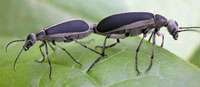
Margined blister beetles

Blister beetles can be quite a sight in the home garden.  About this time of year, their populations build up to incredible numbers.  They amass on and can defoliate plants in a day or two if the infestation is severe enough. They seem to prefer plants in the Solanaceous family like tomatoes, eggplant, and peppers.


Beetles are about a half-inch long.  Their name comes from the defensive chemical, a blistering agent, that is released when they are handled or disturbed. These insects are most active in the morning and late afternoon and may disappear during the hottest part of the day. They are easily disturbed and will drop off the plant or run away if disturbed.

The striped blister beetle has a yellow-orange head and body with three long black stripes running along each wing cover. It will feed on many different vegetables but seems to prefer the fruits of solanaceous plants. They also are foliage feeders with big appetites. Striped blister beetles form large mobile feeding masses so they can descend on an area and cause a lot of damage in a short time. Other species in the area include the black blister beetle and the margined blister beetle. The latter has a black body with thin gray stripes along the wing covers and a gray abdomen. These two species frequently feed on flowers, the black blister beetle can be found on alfalfa flowers.

Pyrethroid products work well against blister beetles.  Neem may be of help as a feeding deterrent.  Organic controls include Neem, spinosad products, and shaking the beetles into soapy water.

Blister beetles can kill horses. For more information, http://www.ca.uky.edu/entomology/entfacts/ef102.asp 

Friday, February 24, 2012

Turf Short Course

I attended one day of the Turf Short Course in Louisville yesterday.  As it turned out, I went to sessions on Landscapes, but came away with some very interesting info.

Steve Higgins presented on water quality and how what landscape professionals do affects our water supply:
  • We all live downstream.
  • KY has over 7000 impaired streams (2010)
  • Test your soil, don't guess.  Only put down the nutrients that are deficient.  Over fertilizing with phosphorus and nitrogen are huge problems, creating dead zones in the Gulf of Mexico.
  • Landowners with streams or creeks or ponds -- establish no mow areas around them.  Mowing close to water's edge destabilizes the soil and allows tons of sediment erosion.  For ponds, this leads to a dying or fast-aging pond.
  • He argues that in subdivisions, just about all areas (even grassy areas) are impervious to water.  Compaction of soil during construction is a huge issue.  Also, contractors regularly bury construction debris.  
  • To reduce runoff, the UK Hospital has created a rooftop garden, very cool.
  • Buy only the pesticides you need.  If your pesticide storage areas are overflowing, get rid of unused or old pesticides by calling the KY Dept of Agriculture's Pesticide Division.
Lynn Rushing presented a wonderful presentation on ponds:
  • Ponds go through natural cycles each year.
  • Ponds, especially those near subdivisions, are the trash cans for the entire area -- pesticide and fertilizer runoff all collects in ponds.  Sediments collect there as well.
  • Healthy pond has good digestion of organic matter -- each year, 1 to 5" of muck accumulate if the pond is not digesting well.
  • Ponds should not be swimming pools -- it's an ecosystem unto itself.  Many life forms share the space and we must respect them all.
  • Algae are very common problems in ponds when the ecosystem is out of balance.  If you use a herbicide to kill 100% of the algae all at once, you will get a fish kill.
  • To manage algae, dredging helps, but only one part of the solution
  • To manage algae, bottom aeration is a great help because it's basically constant dredging.
  • Ponds die every 12 years or so.
  • Canada geese are terrible pests -- one goose can produce 1200# of poop each year, 8 produce as much as a cow.
  • Mallard ducks are wonderful additions to ponds because they eat algae and pond weeds, plus their poop actually inhibits algal growth!  Amazing.
  • Aeration is key, bottom aeration is best, fountains are just for show.  Oxygenating the pond prevents anaerobic digestion and bad odors.  They should even during the winter.
  • Grass carp eat crass, not algae or pond weeds that indicate a healthy pond -- they actually can increase algae growth
  • If you see blue or black lumpy globs of algae, these could be TOXIC.  Cows, horses, dogs can be killed.
Hope you find this as interesting as I do.  Good conference.

Monday, January 31, 2011

Manure Use on Home Gardens -- Watch Out!

Manures can be a great way to add organic matter to a home garden.  I'm for it.  However, be mindful of a few things:

  1. Cow manures that are not well-composted should be used sparingly on gardens where crops like potatoes or onions will be grown.  E. coli is the big deal, and it is a very big deal.
  2. Adding too much of a good thing can be bad.  Manure is a great source of nitrogen.  If the manure is still 'hot' -- not well composted -- you will grow a lot of plant but not many fruit or melons or whatever it is you are growing in your garden.
  3. Lastly, herbicide carryover in manures is a reality.  Some farmers manage their hayfields with herbicides.  Cows eat the hay.  Cows poop.  You gather tht poop up to spread on your garden.  Bad things can happen.  Take a look at this great publication from NCSU

I know this may not be the most interesting subject, but be wise when using manures on your home garden!

Wednesday, November 11, 2009

What does GREEN really mean?

What should it mean? Is it purely subjective? Maybe, I don't know. These questions are purely rhetorical. Does green mean sustainable?

Is growing organically being green? I think it depends. If I'm using something like Neem, which comes from trees in the Indian sub-continent (Wikipedia), and it must be shipped thousands of miles, is that really the best use of resources? Even if I'm using it on an organic garden in Kentucky? Or bat guano? Disturbing bats causes their numbers to decline, so is that sustainable or green?

Buying bagged compost that was made in Florida? Is that green? Is that sustainable?

What about lawn mowing, string trimmers, and leaf blowers? Today's mowers are gas guzzlers. They consume a large amount of energy and pollute our air with fumes and noise. Should we change the way we mow and trim? Should we demand cleaner gas-powered tools?

Is using manures on your gardens being green? Even if some can potentially carry bad, bad organisms that make humans sick?

I don't know the answers to these questions, they are more to ponder. To think about. To maybe change your idea of green.

Monday, October 19, 2009

Pesticide Poisoning? Clean Up When You're Done!

My dog, Lily, is all mutt pup. Not quite a year old, she runs the farm (literally and figuratively). Having had a very calm and slightly handicapped dog before (Emmylou had no right front paw) who passed away last year, I knew what I was in for with a puppy. But you know, you really never do.

Sunday morning she came in the house with tremors all over. She was also heavily salivating. I took her to the doggie ER. They suspected some sort of pesticide poisoning, either a permethrin or an organophosphate (like Sevin).

Although we could find no evidence of any pesticide jug that she had gotten into, it's a good time to bring up the issue of putting away things when you're done with them, especially pesticides if you have animals or kids around.

Lily had to spend the night at the vet but she's home and well now. Animal Care Center and Dr Hall, THANKS!